
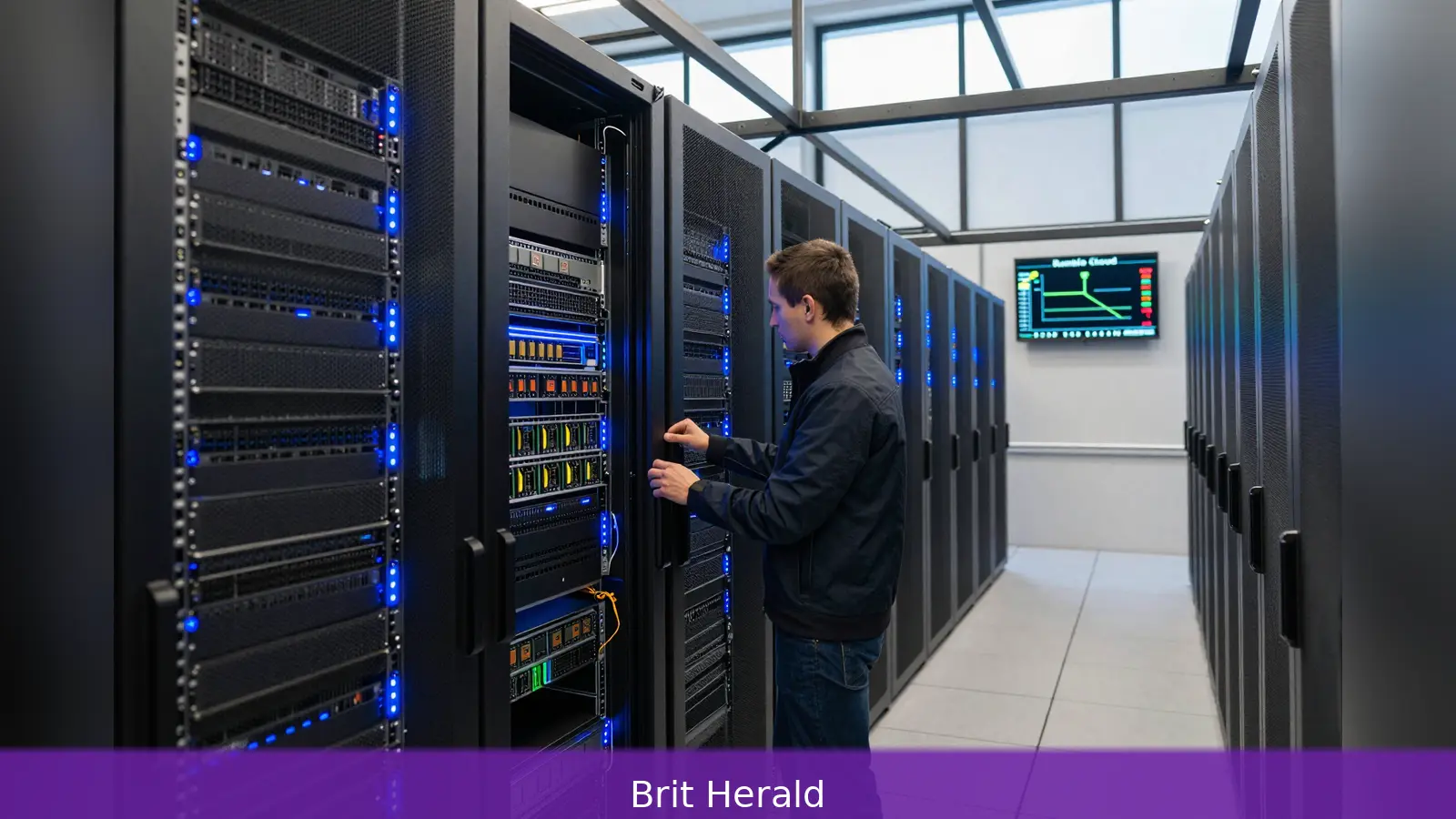
Rumble can now run enterprise-grade AI workloads and sell GPU-backed cloud services after completing its purchase of Northern Data. The all-stock deal, closed in mid-June 2026, transferred roughly 22,400 Nvidia GPUs, including H100 and H200 class cards, and European data-centre capacity to Rumble. Management has reorganised under a renamed holding, RUM Group, and will operate two units: one for AI and cloud infrastructure and one for video services. Christopher Pavlovski, Rumble's chief executive, has stressed the hardware is intended to enhance recommendation models, moderation and video processing rather than mark a fad-like pivot into AI.
The immediate effect is that Rumble now controls the raw compute needed to scale its machine learning workloads internally, because Northern Data's server farms and Nvidia accelerators are now under its control.
What Rumble bought
The transaction, completed in mid-June 2026, was structured as an all-stock deal valued at about $767 million. It handed Rumble roughly 22,400 Nvidia GPUs, a mix that includes H100 and H200 class cards, along with leases on European data centres previously operated by Northern Data. The company has positioned the acquisition as a way to pair its existing video platform with a sizeable infrastructure arm under the RUM Group holding.
The newly acquired GPU fleet and data-centre footprint give Rumble the technical components to offer GPU-backed cloud services aimed at AI workloads, a market today dominated by a small number of hyperscalers. Rumble has already begun to advertise its GPU capacity externally under the Rumble Cloud brand.
The deal also included early commercial commitments. Rumble said there are multi-year and anchor contracts that provide initial revenue support. Management framed those commitments as a bridge to wider sales of GPU capacity to external customers.
How Rumble plans to use the GPUs
Executives describe three principal uses for the new hardware. First, the GPUs will increase capacity for content recommendation and personalisation models, allowing the platform to surface videos based on finer-grained engagement signals. Second, the hardware will power automated moderation pipelines that can flag policy-violating content more quickly than manual review.

Third, the added compute will accelerate video encoding and distribution, reducing latency and supporting higher-resolution streams.
Christopher Pavlovski has repeatedly framed these deployments as enhancements to Rumble's core video business. He has said the infrastructure will feed internal needs first, improving the product for creators and viewers, rather than signalling a wholesale change of identity to become an AI company.
At the same time, the company is clear that the GPU inventory can be monetised. Rumble Cloud is being pitched to external customers who need GPU-backed compute, and the firm argues that predictable pricing makes its offer commercially attractive. Early anchor commitments give the company some initial demand, but management and filings now present cloud services as a potential pathway to larger revenue shares over time.
Those ambitions carry material trade-offs. The hardware and data-centre leases raise Rumble's capital intensity and will require ongoing reinvestment to keep pace with successive GPU generations. Company guidance for 2026 revenue remains modest relative to the scale of the infrastructure shift, and analysts in coverage note the challenge ahead: translating installed GPU capacity into predictable, profitable cloud revenue will depend on client wins, disciplined pricing and clean integration of Northern Data's assets.
Operationally, the new two-unit model lets Rumble separate video product decisions from infrastructure sales. That split may help sales teams pursue enterprise contracts without entangling content moderation or creator monetisation. It also creates a strategic option: if adoption and contract traction materialise, management has indicated cloud could eclipse video as the primary revenue driver over time.
For now the company is balancing immediate internal deployments with an external sales push. Integration work is under way to insert Northern Data's hardware into Rumble's operating model, and the firm is positioning Rumble Cloud for immediate use by both in-house teams and third-party customers.
Analysts emphasise the commercial and execution risks, but also the upside if the company can secure follow-on contracts beyond its anchor commitments. The $767 million valuation and the 22,400 GPU count together make the scale of the move plain. How rapidly that scale converts into recurring cloud revenue will decide whether the infrastructure bet is industrial discipline or a strategic gamble.
Related Articles
- Nvidia Computex keynote: 3 ways to watch
- SpaceX overtakes Amazon, valued at $2.78tn
- Google Workspace promo codes cut up to 14% in June 2026
Rumble's immediate task is integrating Northern Data's servers and converting anchor contracts into repeatable cloud bookings; how quickly it can show growth in cloud revenue will decide whether the infrastructure bet is an industrial win or a strategic gamble.
This article was created with AI assistance.


