
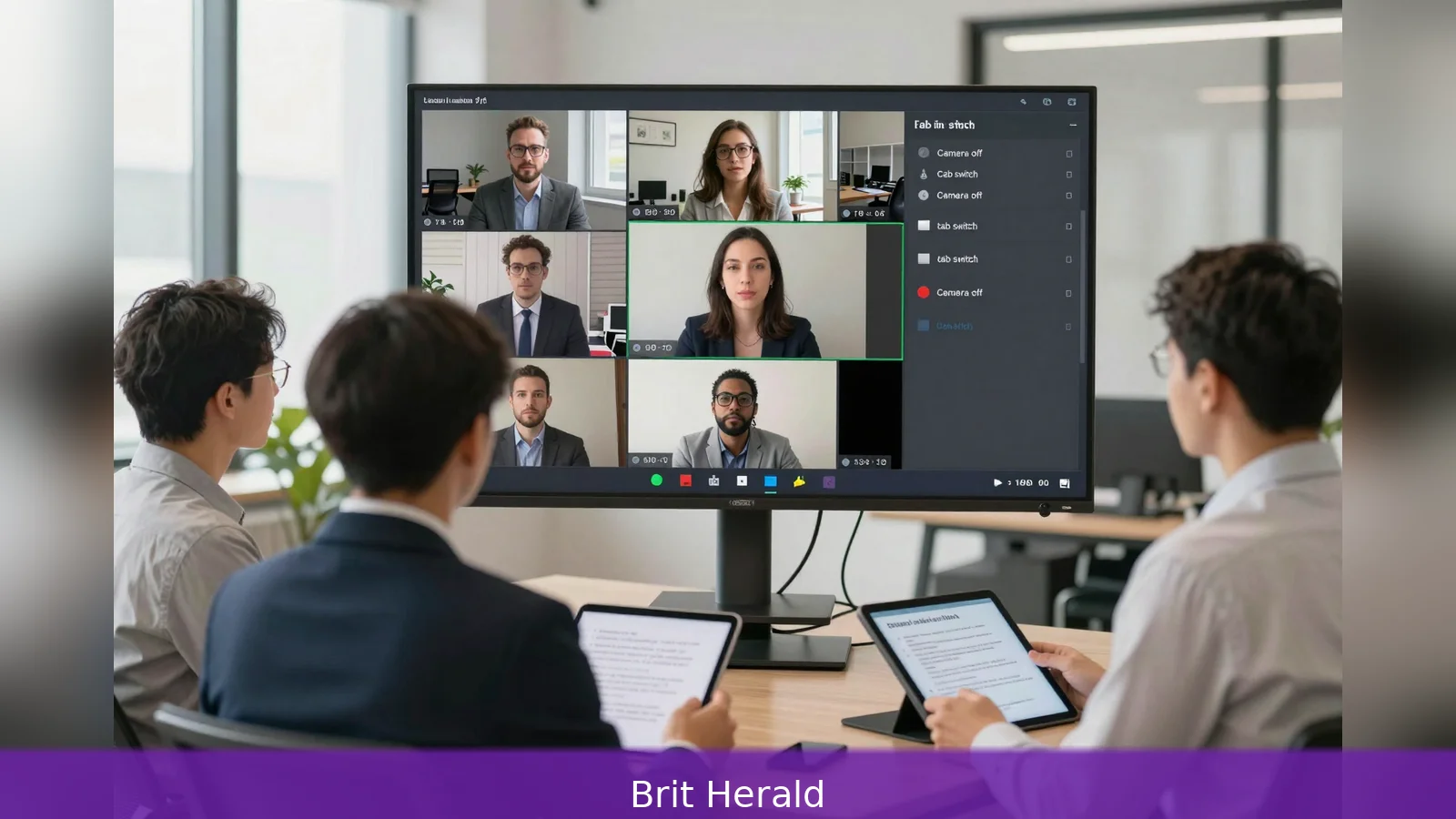
Recruiters are beginning to treat video interviews as forensic evidence. Gartner estimates 25% of candidate profiles worldwide will be fabricated over the next five years. Several large employers have begun adding AI-driven interview integrity tools that log behavioural signals and produce timestamped evidence for reviewers. The systems monitor tab switches, camera-off events and facial patterns and generate short clips so human reviewers can compare interview behaviour with other assessment stages, creating a fresh audit trail for virtual hiring.
25% is the figure shaping vendor sales pitches and hiring-team planning, and it's already changing what recruiters consider plausible when a video interview looks too polished. Vendors now present monitoring outputs as forensic inputs rather than final judgements: short, timestamped clips, recorded tab-switch events and annotated intervals where the camera was off are intended to sit alongside scores and references when panels resolve apparent mismatches.
How the tools work
AI-powered conversational recruiting platforms claim to monitor a candidate session in real time and record a clear chain of custody for any integrity anomalies. The systems commonly record every tab switch with a timestamp and attach a clip of the moment, flag camera-off events with precise intervals, and track prolonged gaze aversion and facial movement patterns. They also analyse response cadence and latency, highlighting answers whose rhythm suggests external prompting. Platforms typically present these signals as evidence for later human review, not as a binary automated hire-or-fire decision.
That distinction matters. Where previously an interviewer might note qualitatively that an answer sounded rehearsed, the new tools provide objective markers that can be replayed and timestamped. For example, tab-switch detection logs each window focus change and attaches the corresponding clip. Camera-off detection marks the exact moment video stopped and started. Response-pattern analysis highlights parts of an answer whose timing appears inconsistent with an unassisted reply. Vendors argue that this produces an auditable chain of evidence that interviewers and hiring managers can compare with coding tests, take-home assignments and on-the-job performance.
Process change as well as software
Employers are responding in two ways: by deploying monitoring software and by redesigning interview processes to reduce moments that are easy to game. Some firms are piloting monitoring tools in live video interviews. Others are shifting formats away from single-question Q&A toward scenario-led discussions, live problem solving and multi-stage evaluations that force candidates to explain their reasoning under pressure. The reported goal of these process shifts is to privilege observable thinking over polished final answers and to make it harder to succeed with canned or AI-generated responses alone.

The cheating techniques cited by practitioners are varied. Rapid tab switching to consult ChatGPT or stored notes, turning off a camera to read prompts or consult an accomplice, concealed earpieces delivering real-time answers, pre-scripted AI-generated responses that collapse under unexpected follow-ups, and identity proxies where another person completes the interview are all documented tactics. Browser extensions that inject prompts or hidden notes into the interview window have also been reported.
Hiring teams say these methods can produce a mismatch between interview behaviour and on-the-job work that would be invisible without session-level monitoring.
The surge in AI use at work amplifies the assessment challenge in certain fields. Research cited by industry commentators shows very high adoption of AI tools among tech workers, which complicates assessment of individual coding ability when AI now assists day-to-day tasks. Employers therefore face a dual pressure: detecting misrepresentation in interviews, and reworking assessments so they measure workplace-relevant skills in an environment where AI assistance is available.
Vendors and hiring teams also emphasise human oversight. Platforms market their timestamped clips and signal flags as inputs for human reviewers rather than as binary pass-or-fail detectors. That framing is intended to address legal and fairness concerns by keeping decisions with trained interviewers and panels, while providing more concrete evidence to support their judgements.
Adoption so far is ad hoc rather than standardised. There's no single model for deployment, pricing or mandatory rollout across markets in the material reviewed. Some large employers have begun pilots that combine monitoring with redesigned interviews. Others are tightening behavioural interviewing and case-led assessments without adopting new software. The concrete change at hand is that interview sessions can now be recorded, timestamped and annotated for integrity signals in a way hiring teams previously lacked, creating a new audit trail for virtual hiring.
Vendors, meanwhile, are sharpening their messaging around evidence and reviewability in order to reassure buyers that human panels remain central to decisions.
That doesn't resolve the harder question of measurement. If a candidate uses AI routinely in day-to-day work, employers must decide whether an assessment that permits some AI assistance is acceptable, or whether an unassisted test remains the right benchmark. The twin challenges of detecting deception and of defining what constitutes the relevant skill set are now inseparable in many technical roles.
Related Articles
- AI to power next UPI wave, NPCI eyes half a billion users
- Oracle cuts 21,000 jobs as it races to build AI data centres
- Meta begins unwind of $2bn Manus deal after Beijing order
Gartner's 25% projection is the concrete datum reshaping hiring practice. Firms are piloting monitoring tools and redesigning interviews, while continuing to place final decisions with human panels.
This article was created with AI assistance.


