
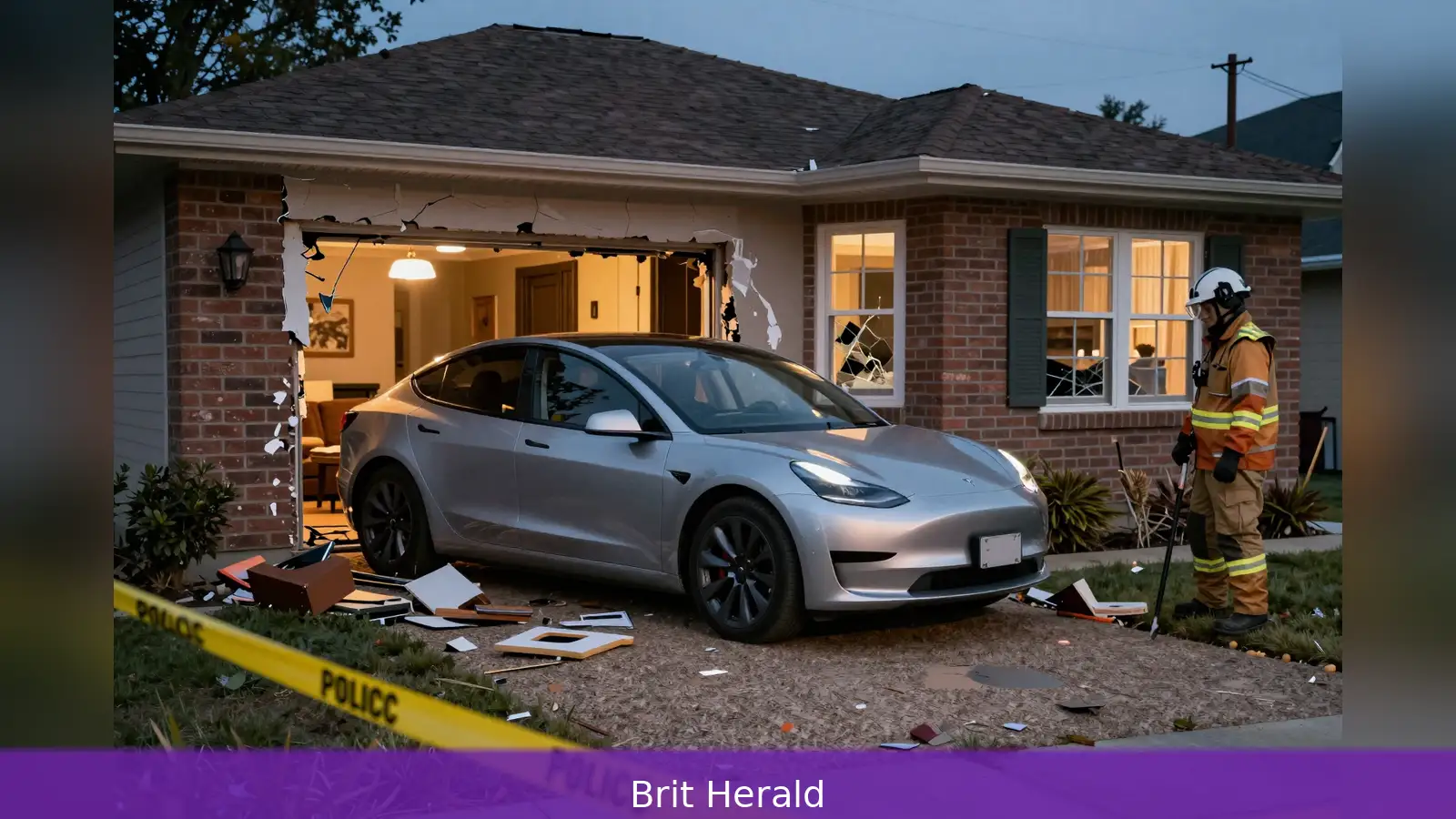
It was dusk on 19 June when a Tesla Model 3 tore through the front wall of a brick home in Katy, Texas, embedding itself amid crumbling plaster and furniture while a family sheltered inside. The crash killed 76-year-old Martha Avila and left the house with a gaping hole where a front room had been. The victim's daughter, Jennifer Barbour, has filed a wrongful-death suit in Texas state court against Tesla and the vehicle's driver, seeking at least $1 million in compensatory and punitive damages and blaming the company’s marketed autonomous driving features. Federal investigators have also opened detailed inquiries, making the wreck both a civil case and the subject of two federal safety probes.
Local television footage picked out the moment the car left the road, streaked across a front lawn and smashed into the Barbour family home, matching police accounts that it left the roadway and struck the residence at speed.
The collision happened at about 20:00 local time on 19 June, Harris County deputies said, and the driver was not intoxicated and cooperated with investigators. Video shows the Model 3 embedded in a front room amid broken plaster and damaged furniture while members of the family sheltered elsewhere in the house. The crash killed Martha Avila, 76.
In a civil complaint filed this week, Avila's daughter, Jennifer Barbour, joined by Justin Barbour, named Tesla and the vehicle's driver as defendants and sought at least $1 million in damages. The suit accuses Tesla of defective design and negligence tied to its promoted autonomous driving features, and it asks for compensatory awards for medical costs and anguish as well as punitive damages for what the filing calls gross negligence by Tesla.
The family’s filing offers a precise version of what happened inside the car: it alleges the vehicle "failed to detect the end of the street," experienced sudden unintended acceleration and continued into the Barbour home with Full Self-Driving engaged. The driver told police the car was operating with an automated driving assistance system at the time, Harris County officials said.
Tesla didn't provide a direct comment to local media requests cited in reports.
Company statements and technical dispute
Elon Musk and senior Tesla software staff have publicly disputed that the company’s software was the proximate cause. Musk posted on X denying that Tesla’s self-driving software was to blame.

Ashok Elluswamy, Tesla’s vice-president of AI software, wrote that the driver had pressed the accelerator and that the vehicle reached about 73 mph (117 km/h). He also said the accelerator appeared to be depressed after the crash. Those points form Tesla’s public technical rebuttal to the family's account.
But the Barbour complaint contests that narrative. The suit seeks to hold Tesla responsible on design and marketing grounds, saying its software and the way the company promotes driver-assistance features contributed to the deadly outcome. The complaint aims to link product design to the sequence of events the family says ended with the car ploughing into their home.
Local police continue to investigate the immediate cause of the collision while federal agencies gather vehicle and crash-scene data. The civil case is proceeding in Texas state court and will run on a different timetable to the federal probes.
Federal scrutiny and precedent
The crash has drawn rapid attention from two federal safety agencies. The National Highway Traffic Safety Administration opened a special crash investigation on the Monday after the wreck, and on the following Wednesday the National Transportation Safety Board said it had launched its own probe in coordination with Harris County authorities. NHTSA’s special crash investigations are the agency’s most detailed inquiries and can lead to safety recalls or other regulatory actions.
Federal scrutiny of Tesla’s assisted-driving systems is broad and longstanding. Since 2016 regulators have opened nearly 50 special investigations into crashes believed to involve advanced driver-assistance systems, the brief notes, and earlier this year the NHTSA escalated a separate review covering millions of Tesla vehicles equipped with the company’s Full Self-Driving software. That wider review and the new special investigation mean the Katy crash lands against a backdrop of continuing regulatory attention to the safety of driver-assistance technology.
Investigators from the NTSB will typically collect detailed scene and vehicle data, while the NHTSA may use its findings to decide whether further action is required. Both agencies are known to seek vehicle logs and software data in crashes where automation is alleged to have played a role. The Harris County sheriff’s office remains active at the scene-level investigation.
The legal case now pending in state court and the federal technical probes run on parallel tracks. The civil complaint asks a court to attribute fault and award damages; the federal investigations can lead to regulatory steps like recalls or safety directives but don't themselves assign civil liability.
For Tesla the stakes are both concrete and reputational. A judgment against the company would bring damages and legal cost, while the federal probes feed into a regulatory picture that has already seen major reviews of the company’s Full Self-Driving software earlier this year.
Related Articles
- Lenovo coupon codes: tiered vouchers and stackable discounts
- Oracle cuts 21,000 jobs as it races to build AI data centres
- Non-nude images harm women and girls, one in five affected
The Barbours' wrongful-death suit seeks at least $1 million in damages. NHTSA and NTSB probes are continuing; their findings could prompt regulatory steps such as recalls, while the state case proceeds on a separate timetable in Texas court.
This article was created with AI assistance.


