
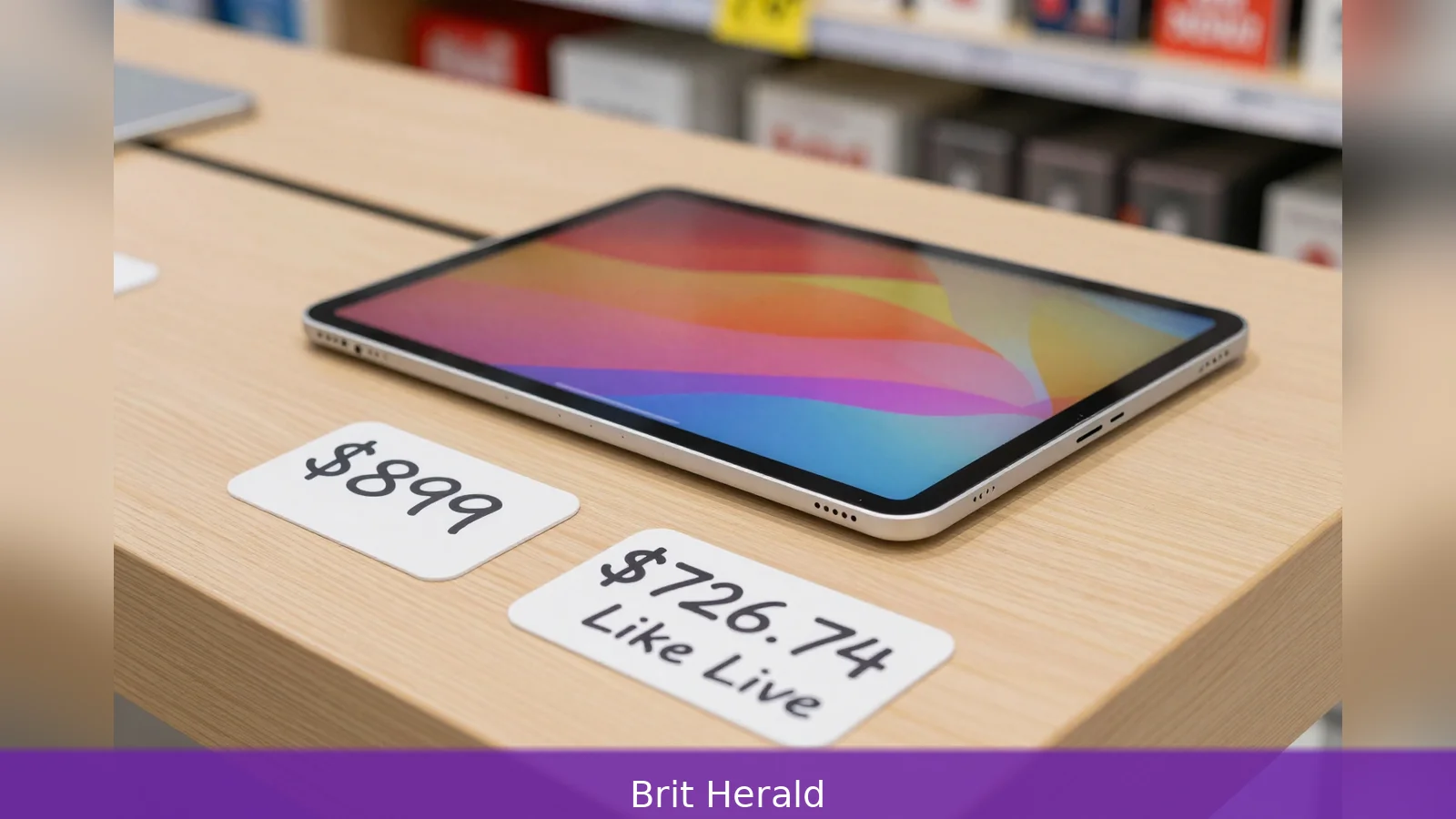
Apple raised the official price of the iPad Pro family in June 2026. Retailers have answered with short-term discounts that have pushed some current M5 models below that new list price, with an 11-inch 256GB model showing a $100 markdown to $899 and certified resale listings falling to roughly $726.74. The result is a narrow buying window for anyone who wants an M5-equipped tablet at a price closer to the pre-hike market.
Apple increased the entry price for its OLED iPad Pro line in June 2026, a change that reset the baseline cost for buyers and forced retailers to respond.
Where the savings are
Retail discounts have appeared quickly. Mainstream listings have shown modest reductions, with one retailer marking the 11-inch M5 iPad Pro with 256GB down by $100 to $899 in a recent sale, according to reporting on the price movement. At the same time Amazon Resale, formerly Amazon Warehouse, has restocked Prime Day-era inventory and listed "Like New" 11-inch M5 units at about $726.74 after an automatic used-stock discount.
Those figures matter because they sit below Apple's June price rise. That creates a temporary arbitrage for buyers willing to shop either new-sale events or certified resale inventories. New-stock discounts are visible on mainstream retailer listings, while the deeper reductions have shown up in certified resale channels where returned or open-box units are graded and resold.
Availability, though, isn't uniform. New-stock discounts are often limited in duration and quantity. Certified resale listings can offer steeper savings, but they depend on what sellers have available, and stock levels can change quickly as units move through resale pipelines.
Why the M5 still matters
The M5 chip is central to why shoppers are willing to hunt for deals. Apple introduced M5-equipped iPad Pro models in October 2025 and hasn't scheduled another refresh for 2026. Benchmarks and vendor summaries place the M5 a step up from the prior-generation M4, with published comparisons showing roughly 15 percent faster CPU and GPU performance and about 50 percent more RAM on typical M5 configurations.
Those are concrete gains for users whose workflows strain earlier tablets.

Hardware and software changes together push the pitch that the M5 iPad Pro can act as a laptop alternative. The tablets use Ultra Retina XDR tandem OLED panels, which Apple says are brighter and less prone to burn-in than conventional OLED. Both 11-inch and 13-inch models support ProMotion at 120Hz, P3 wide colour, and Thunderbolt/USB 4. Accessories include Apple Pencil Pro and Magic Keyboard attachments, and wireless connectivity reaches the latest standards, including Wi-Fi 7 on some configurations.
On the imaging and audio side, the package includes a 12MP Center Stage front camera, a 12MP rear camera with LiDAR, a four-microphone array and a four-speaker audio system. Those components are part of the argument that the iPad Pro is designed for creative professionals and power users who value display fidelity and local compute for photo and video work.
Software shifts reinforce the hardware. IPadOS 26 introduced a redesigned windowing system intended to improve multitasking and multiwindow control, and Apple has tuned the M5's Neural Accelerators to run on-device Apple Intelligence features without round trips to servers. Review coverage and product roundups have emphasised the combination of display quality and local compute as the selling point for those who need to edit, render or prototype on a tablet rather than a laptop.
For shoppers, the arithmetic is straightforward. The June price rise establishes a new reference price that's now being undercut temporarily in some channels.
A new 11-inch 256GB M5 at $899 in a retailer sale sits below Apple's newly posted entry price. A certified "Like New" unit at roughly $726.74 pushes the saving further, though it comes with the usual caveats of used-stock buying and the idiosyncrasies of graded inventory.
There is also a product-timing factor to consider. Apple’s October 2025 refresh remains the most recent update and, according to available information, there's no further refresh scheduled for 2026. That limits the immediate risk that a materially new model will supplant the M5 soon, which in turn makes current discounts more compelling for buyers who prize the chip's incremental performance and the tablet's display and accessory ecosystem.
Still, the market picture is mixed. Discounts can evaporate quickly, and new-stock reductions tend to be shallower than certified resale markdowns.
Buyers who want a brand-new sealed unit at a guaranteed warranty price will find fewer options at the deepest discounts. Those prepared to accept certified "Like New" inventory can realise larger savings but must accept the used-stock condition and the possibility that specific serials or configurations won't arrive with full retail packaging.
For anyone weighing a purchase, the decision narrows to two practical questions. First, whether the performance and features of the M5 justify buying now rather than waiting for a potential future refresh. Second, whether the $100 and deeper certified resale savings are worth the trade-offs of timing and condition. The arithmetic is plain: discounted new-stock sales can place an 11-inch M5 closer to pre-hike prices, while certified resale can take the price significantly lower.
Related Articles
- Family sues Tesla after Model 3 ploughs into Texas home, killing 76-year-old
- Lenovo coupon codes: tiered vouchers and stackable discounts
- Oracle cuts 21,000 jobs as it races to build AI data centres
The concrete pivot is clear: a retailer sale placing an 11-inch 256GB M5 at $899 and certified 'Like New' stock near $726.74. Buyers must choose between a sealed-warranty new unit and deeper resale savings.
This article was created with AI assistance.


