
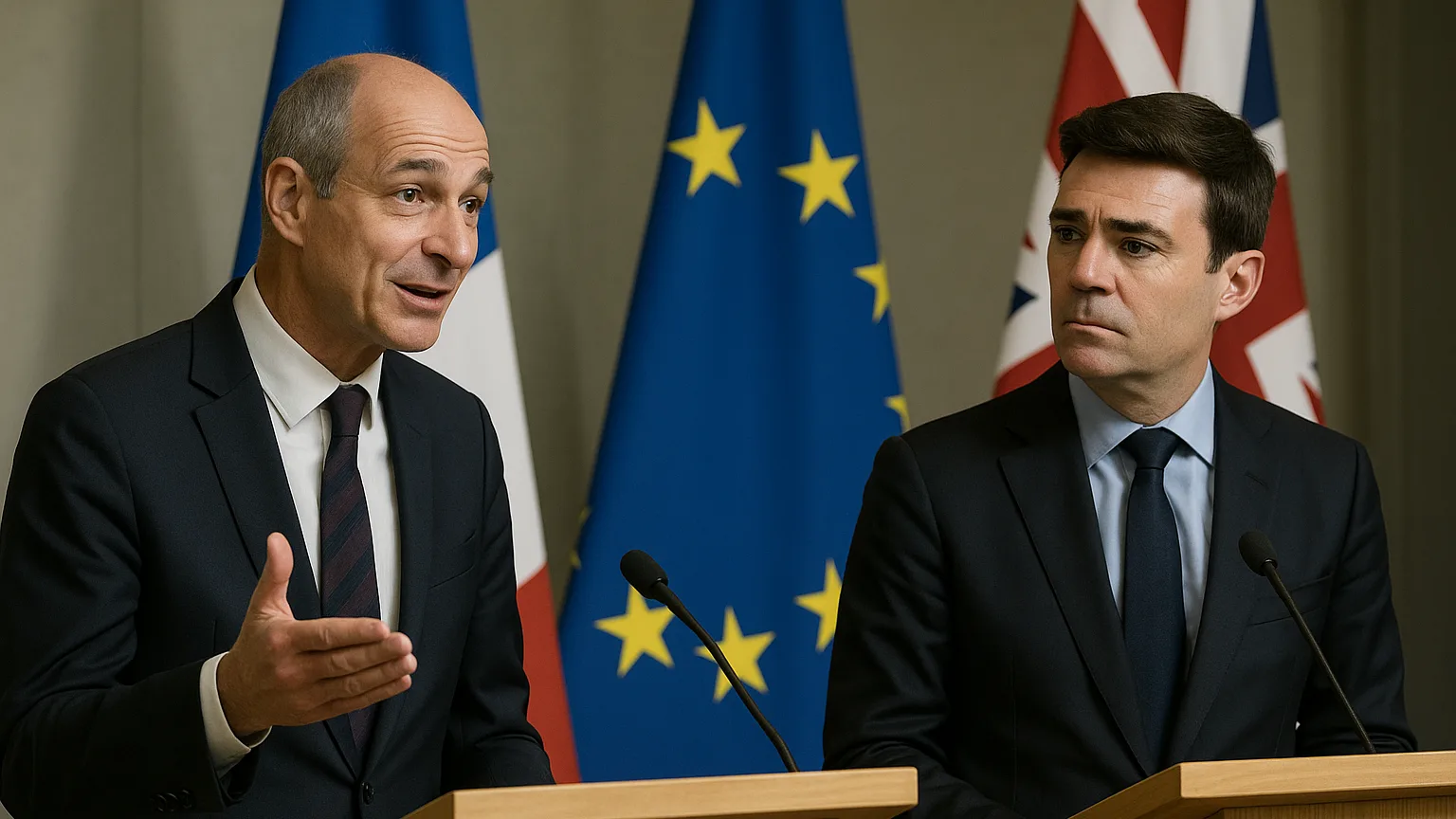
French finance minister Roland Lescure told the BBC the UK is “welcome” to return to the EU after Prime Minister Andy Burnham said his government would set out options ranging from the current deal to full membership.
Lescure’s invitation, and what prompted it
Brussels signalled a political welcome for the UK to return to the EU after France’s finance minister invited Britain to “come back, anytime” on the BBC, saying “if the British people decide to return to the EU, they will have to decide” “come back, anytime”. That public welcome elevated Prime Minister Andy Burnham’s pledge to outline options for the UK’s EU relationship into an international conversation about what rejoining or closer arrangements would entail.
The remarks followed Burnham’s speech at the Labour conference, where he said Brexit had “done more harm than good” and promised to “lay out to Britons what I believe the different options are” for the UK’s future relationship with the EU “what I believe the different options are”. Burnham listed four possibilities in public remarks: keeping the status quo, rejoining a customs union, rejoining the single market, or going “all the way” and seeking full EU membership “preserving the status quo, joining a customs union, joining the single market, or full EU membership”. He said he would seek consensus before committing to any step and added that a future manifesto could include a pledge to hold a vote if public opinion pointed that way, while warning it was “not about leaping to a referendum” Global Morningstar report.
Those public statements have renewed discussion about what each route would mean in practice and how, if at all, the UK might pursue it.
A welcome is not a negotiating offer
Roland Lescure’s comments were a ministerial welcome; they did not create an accession process or agreed terms. Any change in the UK’s relationship with the EU would require UK political decisions and formal negotiations with EU member states.

Rejoining a customs union means the UK could no longer set its own import tariffs. It would have to abandon the tariff agreements it has made since 2020. The UK would need a special arrangement with the EU. The economic benefit depends on regulatory alignment and the deal’s terms. Rejoining the single market is often called the Norway or Swiss option. This would usually require accepting freedom of movement for EU citizens and paying into the EU budget. The UK would apply EU rules but lose voting rights. Full EU membership would restore voting rights and a seat at EU institutions. However, it would require going through the formal accession process that all candidates face.
Domestically, the prime minister’s team will face procedural hurdles before formal negotiations can begin. It must win a clear position through the governing party and decide whether a manifesto pledge commits the government to a referendum or to securing a mandate at a general election; after that, any government would have to win the terms it seeks from EU partners “several procedural hurdles need to be overcome” and “Burnham needs to get his party behind the new approach”. Those are political choices for the UK; the EU’s consent and detailed talks would determine what any new relationship actually looks like.
The economic and political stakes
The choices Burnham has set out determine who makes the rules that govern trade, regulation and cross-border supply chains, and they will influence investment decisions and the UK’s standing with European partners.
France’s finance minister linked the offer to re-entry with practical stakes for industry. He said if the UK were part of the EU, it would “be at the table” for proposals. One example is the EU’s Made In Europe scheme. This scheme aims to favour companies inside the bloc for public contracts and subsidies.
Analysts and opinion writers have set out different assessments rather than settled forecasts. One commentary said “no one seriously pretends that Brexit has not damaged Britain’s economy,” and argued that returning to closer economic integration would involve trade-offs between sovereignty and deeper market access “Brexit has done more harm than good” and “how much independence the country is prepared to sacrifice”. A former EU diplomat warned that warm reactions in Brussels do not remove the “devil in the detail” and that rebuilding trust after a decade of fraught relations will be difficult “the devil will very much be in the detail” and “procedural hurdles”.
Public and political support is uncertain. Polling shows support for rejoin falls if membership were judged to require adopting the euro, and commentators note pro-Brexit parties are polling strongly enough to pose a substantial obstacle; one piece cited pro-Brexit parties at 45% in current polls “support for rejoin fluctuates” and “pro-Brexit parties are currently polling at 45 percent”. These figures are presented as analysis, not as settled outcomes.
Commentators also identify sectoral opportunities and risks, pointing to potential gains from cooperation on defence, energy and carbon pricing while warning of disruption where regulatory regimes diverge, for example in manufacturing supply chains if the UK were excluded from new EU industrial rules “opportunities in defence and security” and “energy and emission trading (the carbon pricing system)”. The government has cited concerns that proposed EU rules could damage UK industry and supply chains “planned EU rules … would damage the UK”.
Burnham has said he will set out the options around the time of a UK-EU summit in November, making that meeting the near-term point to watch for further detail “around the time of a UK-EU summit, which he said would be in November”. Beyond the summit, progress will hinge on the governing party’s choices at home and on the results of negotiations with EU member states.
This article was created with AI assistance.


