
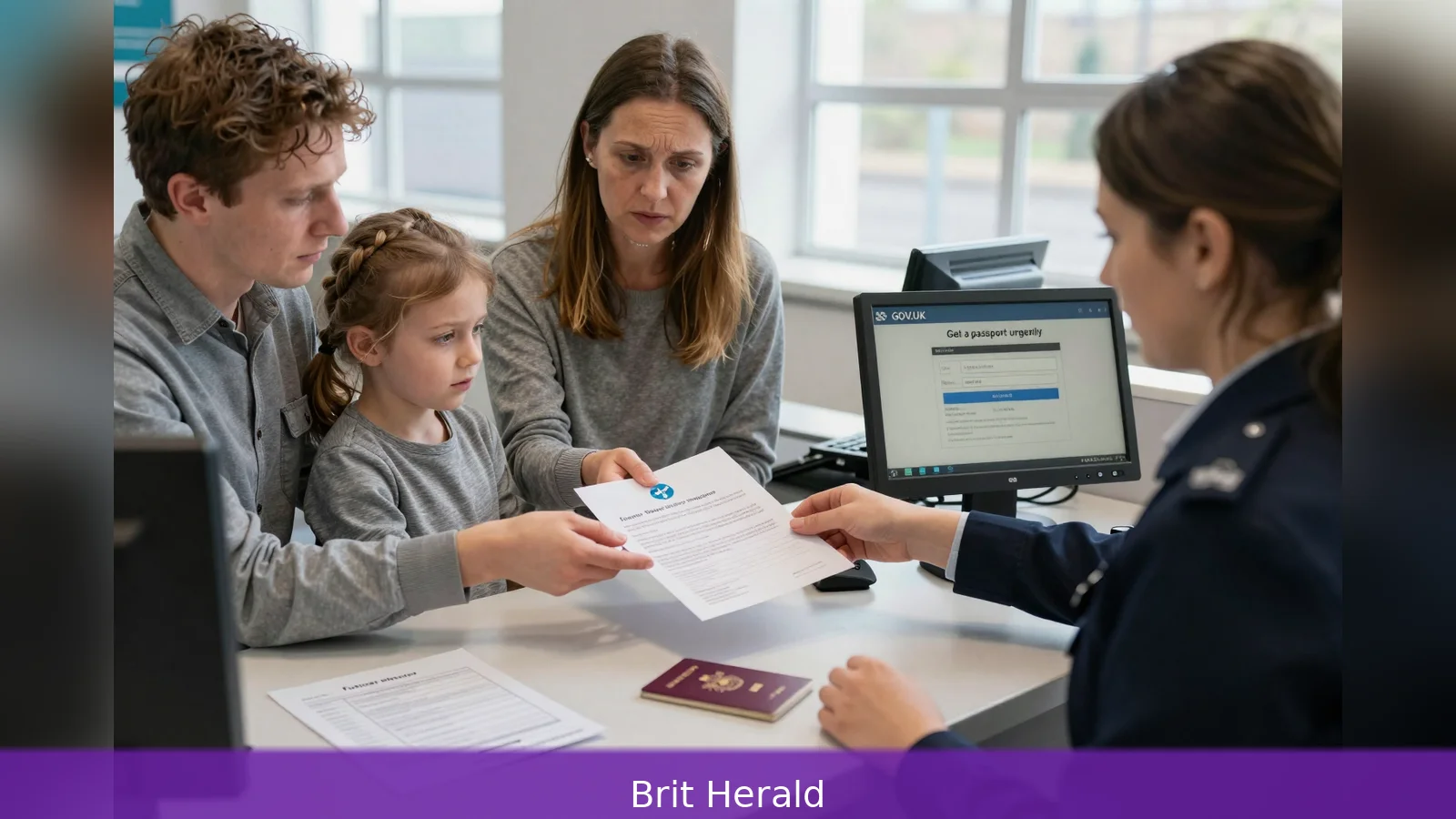
A public pledge to prioritise urgent government business and compassionate passport applications sits uneasily against a rule that any refusal must pass at least two managerial levels. HM Passport Office guidance says customers who qualify for the urgent government business or compassionate route will be prioritised, and it gives public examples such as urgent medical treatment, travelling to a seriously ill family member, or attending a funeral abroad. The staff-facing manuals set out how to start a claim via the GOV.UK Get a passport urgently page, by telephone, or by an online enquiry form, and they spell out the documents and consent evidence required for counter appointments. To begin a claim under the current rules, the guidance tells applicants to contact HM Passport Office through the GOV.UK Get a passport urgently page, by telephone, or via the online enquiry form.
Public pages promise prioritisation, yet internal manuals demand formal case notes and multi-level sign-off before a refusal can take effect.
1. Decide whether your situation fits the urgent government business or compassionate categories
The first decision is binary. Either the reason for travel meets the published urgent government business or compassionate criteria, or it does not. HM Passport Office states that qualifying customers will be prioritised, and the public-facing examples of compassionate reasons include needing a passport to travel for urgent medical treatment for yourself or someone you care for, or because a family member or friend in another country is seriously ill or has died. The guidance is explicit that a last-minute personal trip, such as a booked holiday, isn't a compassionate reason and should be handled through Fast Track, Premium, or a standard upgrade if that option is available.
First, think about the nature of the emergency and whether it matches the examples the Passport Office gives. Second, be prepared to explain timing: how soon you must travel and why the need is urgent. Third, don't assume that turning up at a counter without prior contact will be treated as a U&C case. The public guidance makes initial contact the mandatory first move.
Worked example: a parent told there's a serious deterioration in a distant relative may fit the compassionate route if medical records or a clinical letter confirm the condition and travel is imminent. A holiday booked yesterday doesn't qualify and should be booked under the Fast Track or Premium channels instead.
2. How to start the U&C process
Contact is step one. The staff-facing guidance instructs HM Passport Office staff to direct customers who need a passport for urgent government business or compassionate reasons to the GOV.UK "Get a passport urgently" page, to the HM Passport Office contact centres by telephone, or to the online enquiry form on passport.service.gov.uk. The public pages carrying the compassionate-travel examples likewise tell applicants to contact the Passport Office to find out what to do next. That makes the call, web visit, or submitted enquiry form the mandatory opening move for any U&C claim.
When you call or submit an enquiry, expect the conversation to focus immediately on eligibility and evidence. Staff are trained to establish whether the circumstances align with U&C criteria before arranging any counter appointment. If you can, have basic documentary pointers ready: the name and contact details of the person who's ill, dates, and any hospital or funeral information. Those details won't guarantee a grant, but they will be the threshold for progressing to the appointment stage.
Worked example: an emergency overseas operation scheduled for 72 hours hence. On your call, you will be asked for the operation date, the treating hospital, and the relationship to the patient. If these match the compassionate examples, HM Passport Office will arrange a counter appointment rather than advising you to use Fast Track or Premium.
3. Prepare for the counter appointment and the documentation to bring
If the Passport Office accepts that your case meets U&C criteria, it will arrange a counter appointment and tell you what to bring. The staff-facing guidance sets out the types of documents applicants must provide and specifies the consent evidence required for child applications. The public-facing pages don't reproduce the full list of documents in-line, which means you should expect to be told the exact documentary evidence at the point of contact.
First, bring identity documents and any travel documents you already possess. Second, bring documentary proof of the compassionate or urgent government reason. That could include clinical letters, hospital appointments, a death certificate, or a funeral director's confirmation. Third, for child applications, bring the consent evidence the staff guidance requires; counter staff will check that consent at the appointment. If you don't supply the requested evidence the appointment may be delayed or rescheduled.
Worked example: for urgent medical travel, a referral letter from a clinician or an appointment confirmation from the treating hospital will normally be required. For a funeral, a death certificate or a letter from a funeral director will be the likely documents the counter staff will ask to see.

4. How HM Passport Office processes U&C applications
U&C cases follow a formal, documented workflow rather than the routine processing stream. The processing guidance instructs examiners that when they're ready to issue a passport for an urgent government business or compassionate application, they must add a mandatory case note. The processing guidance has been updated to remove references to the now-withdrawn Expedited service, and it introduces the mandatory case-note requirement as part of the current workflow.
Counter examiners also have specific procedures for handling applications originally submitted on paper where no photo was supplied. The combined message in the staff manuals is that U&C applications are recorded and tracked differently from routine applications, and that examiners are required to record the decision-making steps before issuing a passport. That creates an auditable trail for both grants and refusals.
Worked example: an examiner preparing to issue a passport under the compassionate route will add a case note that records the evidence reviewed and the reason the case meets the U&C criteria. That note becomes part of the file and is searchable by managers who review the decision in any subsequent dispute.
5. Internal checks, refusal controls and what happens if you are told no
Speed for applicants is matched by layered controls for refusals. The guidance places explicit constraints on staff-level rejection of U&C requests. Customer Service Management Team higher executive officers must obtain agreement from a counter manager before rejecting an urgent and compassionate request. Counter higher executive officers are instructed on how to agree with a CSMT higher executive officer decision to reject. In practice, a rejection communicated to an applicant will have passed at least two managerial levels within HM Passport Office.
That structure matters for applicants and advisers because it means a refusal isn't a single-staff decision. Examiners must create mandatory case notes when they're ready to issue a passport, and those notes are equally important when the application is refused. The documentation creates an auditable record of the decision-making and the managerial sign-off chain should you seek internal review or further explanation.
Worked example: if an applicant is told their urgent compassionate claim is refused, request the specific case note reference and the names or grades of the managers who authorised the rejection. The guidance expects decisions to be recorded and to have passed through the counter manager and the CSMT higher executive officer.
6. Alternatives if you don't meet U&C criteria and the next steps
If your reason for urgent travel doesn't meet the U&C categories, the guidance points you to the Fast Track and Premium services for urgent travel or to a standard upgrade if you have already applied and that option is being offered. The processing guidance notes that the Expedited service is no longer available, so Fast Track, Premium or the U&C route are the workable urgent options under the current rules.
First, if you don't qualify, consider whether the Fast Track or Premium services meet your travel timing. Second, if you have already applied and an upgrade is being offered as an option, contact the Passport Office to take that route. Third, if you think your case genuinely did meet U&C criteria but it was refused, the layered managerial sign-off and the mandatory case notes mean you can ask for the recorded reasons and escalate internally.
Worked example: a traveller whose holiday booking becomes urgent the week before departure will be told to use Fast Track or Premium rather than the U&C route. Conversely, someone facing an unforeseen medical evacuation who can provide a clinical letter should pursue the U&C claim and be clear that the Passport Office will arrange a counter appointment once eligibility is established.
Guidance versions and where to ask questions
HM Passport Office published the staff-facing "Urgent government business or compassionate reasons: how to deal with requests" guidance as version 15.0 and updated it on 19 June 2026, with a publication note saying the version was published for Home Office staff on 20 March 2026. The separate processing guidance for examiners was published as version 6.0 and reflects the removal of the Expedited service and the introduction of mandatory case-note requirements. If staff spot text or formatting errors in those manuals, the documents direct them to email the Guidance team.
Practical rules to follow when you make a claim
First, treat the U&C route as an evidence-driven exception rather than a discretionary favour. Second, contact HM Passport Office via the GOV.UK Get a passport urgently page, by telephone, or by the online enquiry form as the first concrete action. Third, be ready to supply documentary proof and any child consent evidence required, and expect counter staff to check those documents at the appointment. Fourth, if the application is refused, ask for the mandatory case-note reference and the names or grades of the managers who authorised the decision.
Worked scenario
Picture a family needing passports for two adults and one child to travel because a grandparent in another country has been taken seriously ill. They call the Passport Office, explain the relationship, provide the hospital contact and the anticipated travel dates. The Passport Office arranges a counter appointment, tells them what documents to bring including clinical confirmation and child consent paperwork, and informs them that decisions will be recorded with mandatory case notes. If the request is refused, the family can expect that the refusal was agreed by a counter manager and a CSMT higher executive officer and that the case notes will show why.
Related Articles
- Gangmaster licence: 10-week application and renewal guide
- Sell Digital Products in 2026: 10 Steps to Start
- 8 steps to launch a tech product that actually scales
In short: - Contact HM Passport Office via the GOV.UK Get a passport urgently page, by telephone, or using the online enquiry form as your first step. - Treat the U&C route as evidence driven: bring clinical letters, hospital confirmations, death certificates or funeral director letters, and any child consent paperwork required. - If your claim is refused, ask for the mandatory case‑note reference and the names or grades of the managers who authorised the decision, and use those details to pursue an internal review.
This article was created with AI assistance.


