
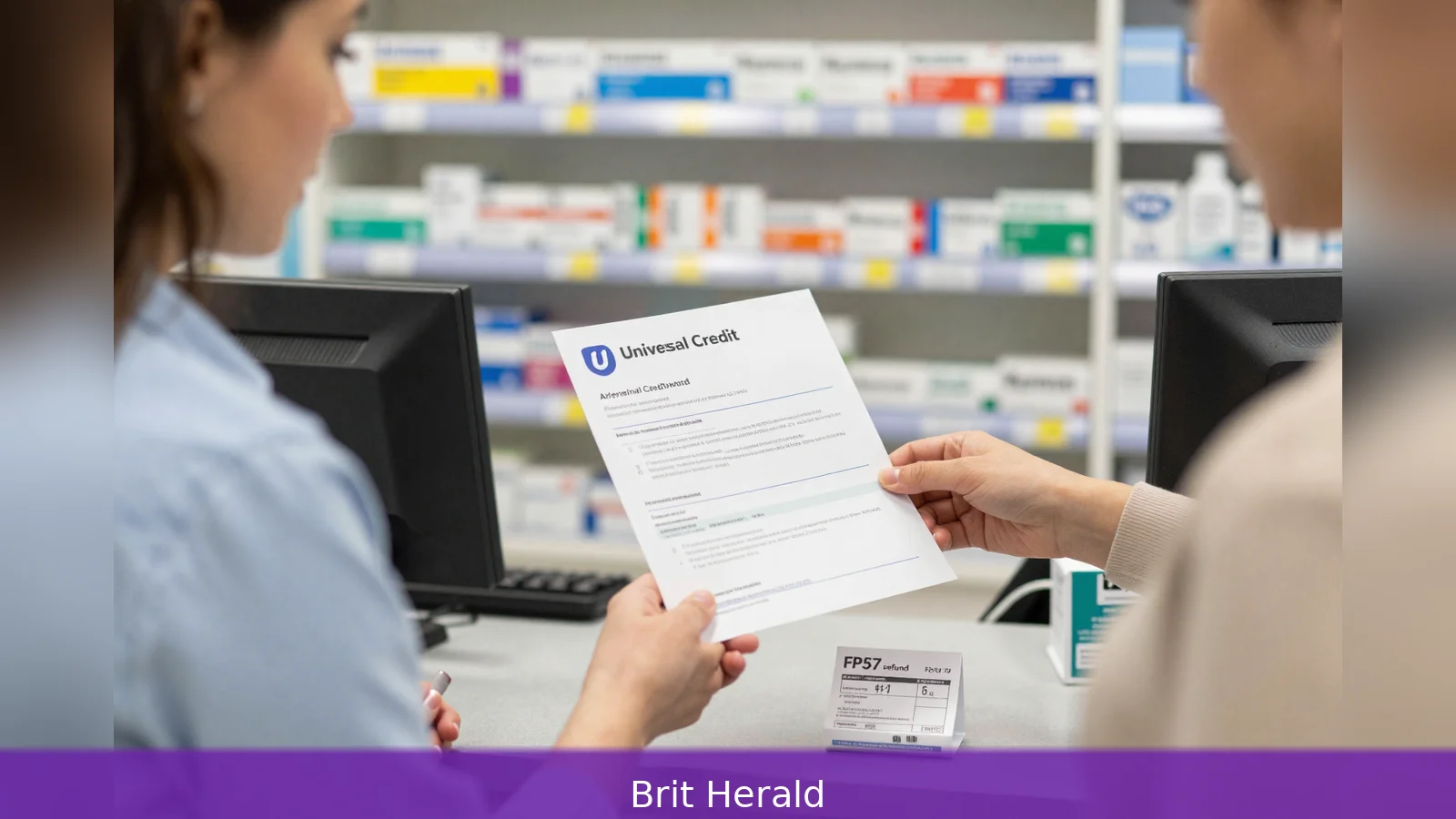
Can someone on Universal Credit always get free NHS prescriptions? No: receipt of Universal Credit alone does not guarantee free prescriptions. Entitlement depends on your household's net take-home pay in the most recent Universal Credit assessment period. The NHS Business Services Authority applies a lower threshold and a higher threshold where a child element or limited capability for work applies, and it requires claimants to show their Universal Credit award notice when collecting medicines. If you have not yet completed a first assessment period you will usually need to pay at the counter, take an FP57 refund form and reclaim once your earnings are confirmed.
1. Why Universal Credit doesn't automatically mean free prescriptions
Why does receipt of Universal Credit not automatically make prescriptions free? The NHS Business Services Authority, which administers help with NHS costs, treats Universal Credit as a route to entitlement rather than a blanket exemption. Entitlement depends on a household income test applied to the most recent Universal Credit assessment period that ended immediately before you make the claim.
The rule is straightforward in form. Add together the net take-home pay of everyone in your household for the assessment period in question. If that combined total was at or below the lower threshold you qualify for help with NHS costs, including free prescriptions. A higher threshold applies where your Universal Credit award includes a child element or where you had limited capability for work. These thresholds and the definition of take-home pay are set out by the NHS Business Services Authority.
Net take-home pay means earnings after tax, National Insurance and pension deductions. The authority also points out that self-employed claimants follow a different calculation for net earned income, and it directs them to GOV.UK for the exact method used under Universal Credit.
Worked example: imagine a two-adult household whose combined take-home pay in the last assessment period fell below the lower test and so the household qualifies. If the same household included a dependent child and the income fell below the higher test, that higher test would allow entitlement.
Documentary routine when you collect a prescription
How do you prove entitlement at the pharmacy, GP surgery or hospital? The NHS Business Services Authority sets a simple proof-and-claim routine. Your primary document is the Universal Credit award notice.
Present that notice when you collect a prescription and the dispenser may accept the claim for free treatment.
The authority advises that when entitlement is because take-home pay met the Universal Credit test you should indicate Universal Credit on the prescription form. If the form in front of the dispenser does not include a specific Universal Credit option, follow the alternative instructions on the form for income-based benefits. Pharmacies and other dispensing locations may ask to see the award notice before accepting a free claim, so keep copies or photographs of your notice to hand.
Worked example: at a high street pharmacy the prescription form includes an option for Universal Credit. You present your award notice and the pharmacist checks it. If the form instead contains a general box for income-based benefits, you would use that and show the same award notice as evidence.
If you have not yet had a first Universal Credit payment

If you have just applied for Universal Credit and have not completed a full assessment period, what then? The NHS Business Services Authority recognises the practical problem: entitlement cannot be calculated until an assessment period finishes. Its instruction is to pay for the prescription at the counter, ask immediately for an FP57 refund claim form, and keep the receipt and the completed FP57.
Once your first assessment period has ended and your earnings are confirmed to be below the relevant threshold, submit the FP57 and the receipt to claim a full refund for the charges you paid. The NHS Business Services Authority makes clear the temporary need to pay is a procedural consequence of not yet having the completed earnings assessment.
Worked example: you apply for Universal Credit and collect a prescription before your first assessment period ends. You pay at the counter, request an FP57, keep the receipt and later, after the assessment confirms your earnings were below the relevant threshold, you submit both the FP57 and the receipt to the authority to reclaim the amount you paid.
Edge cases, disputes and practical warnings
Who does not qualify even though they receive Universal Credit? The NHS Business Services Authority is explicit that receipt of Universal Credit alone is not enough. New-style, contribution-based benefits such as new style Jobseeker's Allowance and new style Employment and Support Allowance do not give automatic entitlement; people in those categories may need to apply to the NHS Low Income Scheme instead. Partners and dependants who are covered by other qualifying awards, for example Pension Credit Guarantee Credit, are covered as the award specifies.
If a pharmacy refuses a free claim you believe is valid, or if you need help with a refund, the NHS Business Services Authority has customer guidance and contact routes on its prescriptions and refunds pages. Keep receipts and any completed FP57 forms. For disputes about the particular calculation of self-employed earnings under Universal Credit the authority directs claimants to GOV.UK guidance on the subject.
Practical warning: do not assume entitlement from the word "Universal Credit" on your award notice. The deciding factor is the take-home pay test for the assessment period that ended immediately before you make the claim. If you are unsure what to include in your net take-home pay total, follow the NHS Business Services Authority instruction and consult GOV.UK for the rules that apply to self-employed income.
4. Other automatic routes to free prescriptions and common exemptions
Are there routes to free prescriptions that do not depend on the Universal Credit income test? Yes. The NHS Business Services Authority lists several groups and certificates that provide automatic entitlement regardless of Universal Credit. These include people aged under 16, those aged 16 to 18 in full-time education, anyone aged 60 or older, claimants of Income Support, and those receiving Pension Credit Guarantee Credit. Income-related Employment and Support Allowance is another benefit that carries automatic entitlement.
Separate exemptions cover maternity and certain medical conditions, and certificates are required to claim under those routes. For example, people who are pregnant or have had a baby in the previous 12 months need a valid Maternity exemption certificate. Medical exemption certificates are issued for a specified list of conditions and for some forms of continuing physical disability that make leaving the home difficult. Those certificates replace the Universal Credit test and require different supporting evidence, such as a GP or hospital form.
Finally, some prescribed items are always free, for example contraceptives and medicines administered to hospital inpatients. The NHS Business Services Authority provides a list of those items in its guidance.
In short
1. Check the last Universal Credit assessment period. If household net take-home pay was at or below the lower threshold you qualify for free prescriptions, or at or below the higher threshold if your award has a child element or you had limited capability for work.
2. Bring your Universal Credit award notice when you collect a prescription and indicate Universal Credit on the prescription form. If no specific Universal Credit option exists, use the form's alternative for income-based benefits and show the same proof.
3. If you have not completed a first assessment period, pay at the counter, request an FP57 refund form immediately, keep the receipt and submit the FP57 after the assessment confirms earnings below the threshold.
4. Consider other routes and exemptions: maternity and medical exemption certificates, age-based exemptions and certain benefits provide automatic entitlement without reference to the Universal Credit test.
Related Articles
- Stop unsafe retraining: map, gate and prove your data
- 5 steps from Cory Doctorow show the real price of AI
- 8-step guide to greens powders you'll actually drink
When you next collect a prescription, show your Universal Credit award notice and indicate Universal Credit on the prescription form; if no specific option exists use the income-based benefits box and show the same notice. If you are within your first assessment period, pay at the counter, ask for an FP57 refund form, keep the receipt and submit both after the assessment confirms your earnings.
This article was created with AI assistance.


