
Map the data path, gate inputs and prove provenance to stop unsafe retraining. A stack of terminal windows, a streaming queue and a column of user feedback waiting to be ingested: in that moment a single unchecked pipeline can seed poisoned data into every future model. For many teams the question is not whether to retrain but how to stop unsafe retraining from happening by accident, particularly in a UK SME where the result is not only lower accuracy but loss of confidence, biased decisions and hidden behaviours that surface in narrow conditions. The controls are practical and procedural: map every data path, capture provenance, apply curation and validation, version artefacts and enforce release gates so retraining cannot proceed on contaminated inputs. Start by mapping the pipeline and annotating who owns each trust boundary, then make provenance, validation and release gates operational.
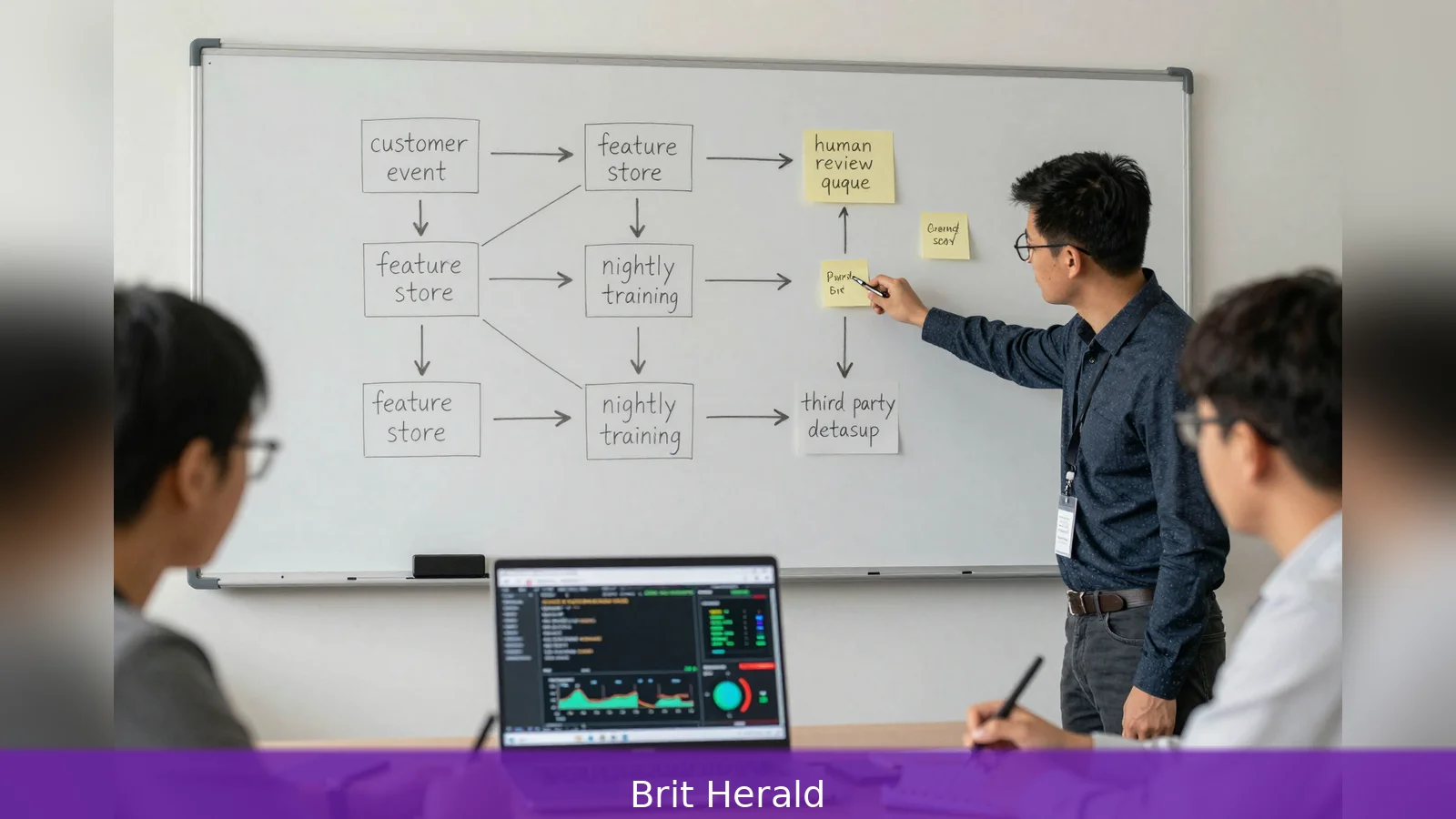
On a whiteboard in a cramped meeting room, arrows mark where data arrives, where labels are edited and where automated feedback might loop back into training. That diagram isn't an exercise in neatness. It's the single most effective defence against accidental poisoning of your model lifecycle.
1. Map the pipeline and mark trust boundaries
Map the pipeline first, and treat that map as the actionable starting point. Show where raw data is collected, where labels are created or edited, where feature extraction runs, where synthetic data or augmentation is generated and where user feedback might fold back into training. In this map, every handoff is a potential trust boundary: a feature store, a human review queue, a synthetic data generator, a third party dataset, an automated feedback stream or a model registry. Make those boundaries explicit.
Each node on the diagram needs three things: an owner, an explicit trust level and a documented policy for whether and how it may supply data into a training run. Common entry points for poisoning to watch for are third party datasets, manual review queues, automated feedback folded back into training and untracked label overrides by analysts. Mark them clearly so the organisation can see where risk concentrates.
Worked example: draw the flow from customer event to production feature store to nightly training job. Label the human review queue that edits labels as "high risk" and assign an owner. That one simple act exposes whether feedback is folding into training with no gate.
2. Capture provenance and make it operational
Capture provenance for every dataset, every transformation and every label change. Record metadata that links each item to its source, its transformation history and the person or process that authorised changes.
Make provenance first class production telemetry and ensure it travels with the artifact into the model registry and training runs.
Use immutable snapshots of training sets so any model can be traced back to the exact inputs used to build it. The objective is to remove ambiguity about where a training example came from and whether it passed the filters required to be accepted into a tranche that could trigger retraining. If an analyst asks why a model changed, you must be able to point to the dataset snapshot, the validation report and the release gate decision that permitted deployment.
Operationalise provenance by integrating it into your tooling. Ensure every dataset version, every label revision and every transformation carries a compact provenance record. Store that record where automation and humans can inspect it during validation and incident response.
3. Apply curation and validation before anything becomes a retraining input
Gate data with checks before it enters any retraining pool. Automated checks should cover schema, field ranges and label distributions. Higher level checks should test for plausibility and adversarial signals. Treat synthetic data and augmentation pipelines as distinct sources with their own failure modes and validation needs.
Keep an isolated evaluation set that's never updated from live feedback so model performance can be measured against a stable benchmark. The validation checks that gate a dataset must be defined and versioned alongside the datasets they protect so you can demonstrate what rules were in place for any given model version. Separate raw feedback from curated examples; require curated examples to pass the validation suite before they become eligible for retraining.
Worked example: a nightly job rejects any candidate training set whose label distribution shifts beyond a preconfigured threshold. Rejected sets are quarantined and require human review before any further action.
4. Control labels and human review
Treat labels as fragile assets. Human review queues are a frequent contamination point when overrides occur without traceability. Require that any change to a label or ground truth is recorded with a rationale, the reviewer identity and a link to the provenance for the original item.

If analysts need to revise labels, capture the revision as a candidate correction and place it in a quarantined staging area until it passes validation and is approved for inclusion in retraining. Avoid the shortcut of bulk acceptance of human edits into training pools with no audit trail and no acceptance gate.
Make label-change workflows explicit. The policy can be compact: every manual edit generates a revision record, revisions are batched into candidate datasets, candidate datasets must clear the validation suite and require a named approver before becoming part of any retraining run.
5. Enforce release gates with a model registry
Do not let feedback pipelines automatically trigger retraining and redeployment. Route candidate training sets and model checkpoints into a registry where they're held until they satisfy a release checklist. The checklist should reference provenance checks, validation test results on the immutable evaluation set and a human sign-off that reviews unusual distributional changes or flagged anomalies.
Version every model artifact and every dataset so that a deployment can be rolled back to a known good state and the exact inputs that produced that state can be inspected. Holding candidate artifacts in a registry creates a deliberate pause where the team can spot contamination before the model reaches users.
Worked example: a registry that refuses to promote model v12 unless its training snapshot provenance is complete, the validation suite shows no regression on the held-out set and an approver has recorded why distributional shifts are acceptable.
6. Distinguish data poisoning from runtime attacks
Make the distinction operational. Runtime threats such as prompt injection require input filtering, tool isolation and output constraints at inference time. Data poisoning targets the training lifecycle and must be addressed with provenance capture, curated datasets, validation pipelines and release gates. Treat both classes of risk within a mature security programme, but apply distinct mitigations at the stage where an adversary can act.
Do not rely on the same controls for both problems. Document the difference in your testing plans and in your incident playbooks so that teams know whether to quarantine inputs, roll back a model or harden inference-time filters.
7. Design evaluation to probe hidden behaviours
Test beyond accuracy. Poisoned data can embed backdoors or create blind spots that standard metrics don't reveal. Keep a held-out evaluation set that's representative and stable across versions, and augment it with targeted tests that emulate likely poisoning scenarios relevant to your use case.
Include checks for fairness, safety and distributional shift. Require that a model only progresses toward deployment when it passes those tests and when the provenance of its training data is fully reconciled with the registry. These tests should be versioned and recorded so the team can show what evaluation a model passed at release.
8. Treat feedback loops as gated channels
Gate live feedback rather than folding it straight into retraining. Customer feedback, analyst annotations and production labels are valuable, but they should enter retraining only after curation, validation and human review. Where continuous learning is necessary, isolate experiments to offline training runs and shadow deployments so production behaviour isn't affected until the new model has been validated against the stable evaluation set and the provenance records.
Make it policy that automatic inclusion of live feedback into retraining is forbidden unless a documented and audited change control process approves it. That single rule prevents a cascade where a small number of malicious or mistaken inputs corrupt a production model.
9. Instrument production and keep auditability simple
Log model outputs and provenance so retrospective investigation is straightforward. Ensure that model outputs, key input features and metadata about which dataset and model version produced each output are logged and stored to support audits. Simplicity matters: a compact, well indexed set of logs is more useful in an incident than a sprawling telemetry mountain you can't query.
When an analyst asks why a model changed, you must be able to point to the exact dataset snapshot, the validation report and the release gate decision that permitted deployment. That level of traceability prevents silent drift and makes it possible to stop a problematic retraining sequence before it affects users.
10. Assign ownership and rehearse incident response
Give each data source and component an owner. Each data source, transformation and model component should have an owner responsible for enforcing the trust boundaries you mapped. When anomalies appear, a rapid process for quarantining suspect datasets, rolling back model versions and investigating provenance discrepancies reduces harm.
Governance need not be heavy. Even a compact set of responsibilities and an emergency rollback playbook will make accidental or malicious retraining far less likely to cause lasting damage. Ensure the playbook specifies who can quarantine data, who can approve rollbacks and who's accountable for post-incident analysis.
Begin with one practical step
Start by mapping the full data path. The lowest friction, highest impact action is to map the full data path from source to production and annotate the diagram with the trust owner for each node. That map exposes where feedback is folding back into training, where human edits occur without traceability and where third party inputs enter.
With the map in place, deploy the next set of controls in sequence: provenance capture, validation gates, dataset versioning and a model registry with enforced release gates. These are concrete engineering controls that together stop most accidental retraining events.
In short, preventing unsafe retraining isn't a single tool. It's a disciplined lifecycle: map the flow, attach provenance, gate inputs, control labels, version artefacts and enforce release checks. Those measures make retraining a deliberate, auditable action rather than a risk borne of an unattended feedback pipe.
Related Articles
- 5 steps from Cory Doctorow show the real price of AI
- 8-step guide to greens powders you'll actually drink
- Undav snatches 2-1 stoppage win, Germany into last 32
Begin by drawing the full data path and naming an owner for each node. That single diagram shows where feedback is folding into training, where manual edits lack traceability and where third party inputs enter. With the map in place, deploy provenance capture, validation gates, dataset versioning and a registry that enforces release checks. Those controls make retraining a deliberate, auditable action rather than an accidental risk from an unattended feedback pipe.
This article was created with AI assistance.


