
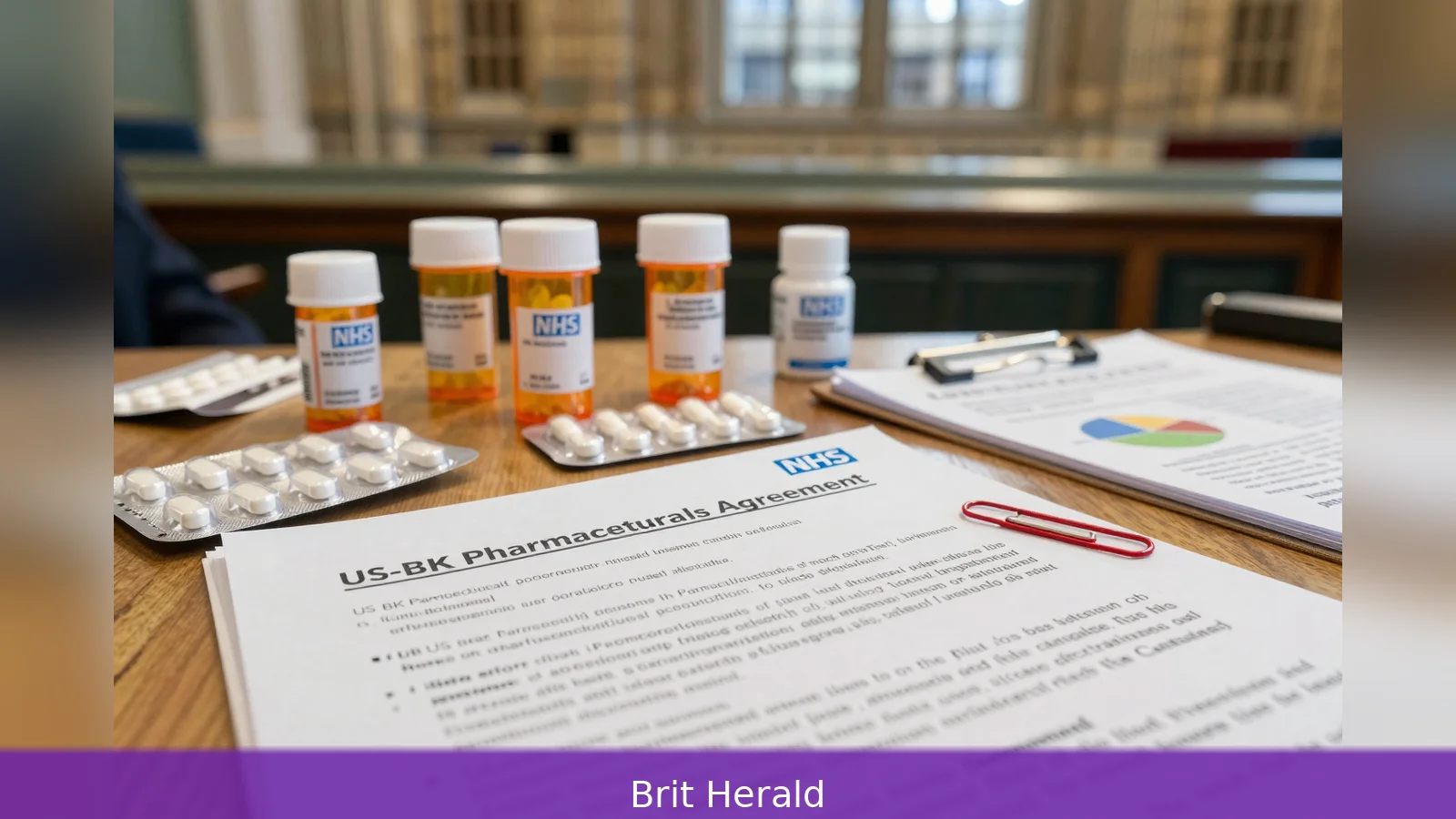
The government says the US-UK pharmaceuticals package will add about £1bn to drug spending between 2025-26 and 2028-29, yet independent analysis finds the NHS would need roughly £44.7bn by 2036. Ministers framed the deal, agreed on 1 December 2025, as protection against US tariffs and a boost to life sciences cooperation, and they took powers in March 2026 to ask the National Institute for Health and Care Excellence to use higher cost-effectiveness thresholds. A paper published in the British Medical Journal on 1 July 2026 by researchers at the University of York, the University of Liverpool and Christchurch Hospital in New Zealand concludes the agreement commits the NHS to about a 25% uplift in net prices for new branded medicines and to a doubling of spending on innovative therapies to 0.6% of GDP by 2036.
The government's near-term figure and the BMJ's long-term projection sit uneasily together, and that mismatch is driving urgent scrutiny in Westminster. One side points to a tidy near-term cost of about £1bn for 2025-26 to 2028-29; the other warns of a systemic shift that will leave the NHS paying far more for branded medicines over the coming decade.
Ministers presented the package, agreed on 1 December 2025, as a way to secure 0% tariffs on UK pharmaceutical and medical device exports to the US for three years while encouraging life sciences cooperation. But the BMJ analysis, authored by Samuel Cross, Karl Claxton and Andrew Hill and published on 1 July 2026, finds the agreement also alters the pricing environment for new branded drugs sold to the NHS.
The paper, produced by researchers at the University of York, the University of Liverpool and Christchurch Hospital in New Zealand, says ministers used powers in March 2026 to instruct the National Institute for Health and Care Excellence to apply higher cost-effectiveness thresholds when assessing new medicines. The change, the authors argue, will make more expensive treatments eligible for NHS use and effectively guarantee higher net prices at launch.
The BMJ modelling concludes those changes amount to roughly a 25% uplift in net prices for new treatments over the coming decade. It also projects that spending on innovative therapies will rise from about 0.3% of GDP to 0.6% by 2036. That degree of uplift is large enough, the authors say, to reshape drug budgets and the bargaining dynamics between the NHS and pharmaceutical companies.

The BMJ team modelled how the higher prices would play out across the health system and concluded the NHS would need to find about £44.7bn by 2036 to cover the increased drug bill unless additional funding is provided.
To meet that figure, money would have to be diverted from other services, and the authors estimate such reallocation would cause roughly 229,000 excess deaths in England by 2036.
Including indirect impacts through adult social care raises the estimated toll to about 291,000 excess deaths. The paper identifies most preventable deaths as occurring among people with cardiovascular, respiratory and gastrointestinal disease and cancer. The authors note the projected avoidable death toll exceeds recorded deaths in England during the Covid-19 pandemic period that the report cites for comparison.
Ministers and pharmaceutical industry executives argue the deal protects UK exporters from tariff risk and preserves patient access to potentially life-extending drugs, and they point to the commercial benefit for British drug makers of removing uncertainty on US tariffs. Campaign groups, opposition MPs and the BMJ authors counter that the primary beneficiaries will be producers of high-priced branded medicines, while the NHS and patients will bear the opportunity cost through cuts or slower expansion of other services.
The analysis argues that higher approval thresholds combined with guaranteed higher net prices will blunt incentives for industry to negotiate lower launch prices for the NHS. That shift in bargaining power is now central to the political argument: supporters say the change secures trade and innovation, critics say it reshapes domestic pricing policy in favour of manufacturers.
Beyond the numbers, the deal has raised procedural questions. Critics say parliament and the public were given too little detail before the changes took effect, and MPs have pressed the government to publish its own impact assessment of the agreement. The contrast between the government's £1bn near-term cost estimate and the BMJ's long-run projection has become a focus of hearings and media attention.
Related Articles
- Wayve opens $85m staff tender at $8.5bn valuation
- Burnham plan could raise London bills by £7.5bn
- $7 ESP32-S3 blocks whole-home ads in minutes
MPs and campaign groups are now using the BMJ figure to demand the government publish its own impact assessment and disclose the modelling behind the agreement.
This article was created with AI assistance.


