
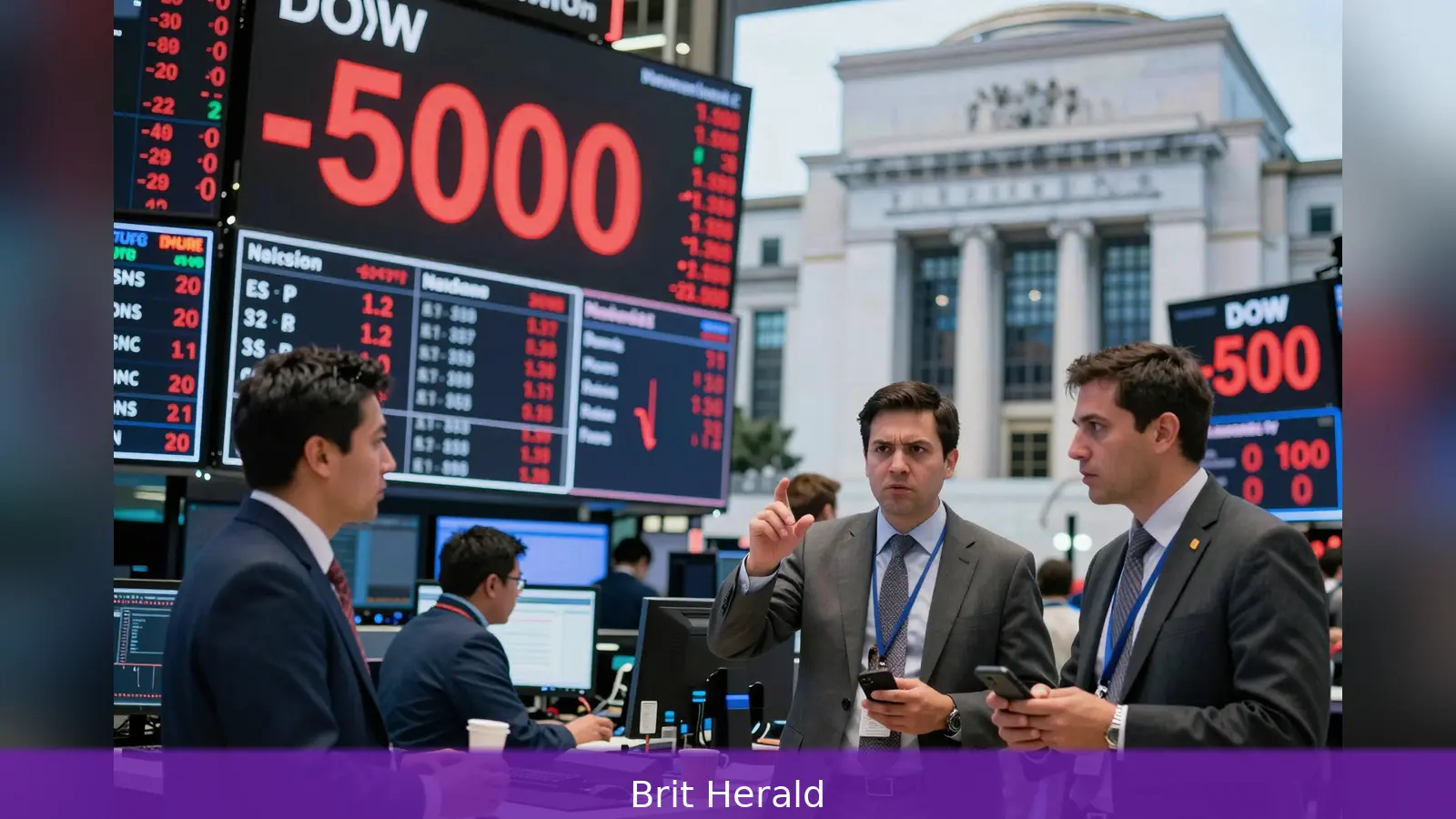
A near-500-point slide in the Dow signalled markets had read the Federal Reserve's message as one of tightening, not pause. The Fed left the federal funds target at 3.50%-3.75% but issued a shorter statement, removed language that had hinted at future cuts and closed with the line, "The Committee will deliver price stability." A hawkish dot-plot and Kevin Warsh's first post-decision press conference, in which he declined to supply his own dot and announced five taskforces to review the Fed's practices, pushed the dollar and bond yields higher and sent US equities lower. The Dow fell about 500 points, while the S&P 500 and Nasdaq were each down roughly 1.2 per cent as futures traders lifted the odds of a December hike.
Bond yields and the dollar climbed, reflecting investor reaction to the Fed's unchanged 3.50%-3.75% federal funds target and a notably hawkish outlook from officials. The committee's brief statement dropped language that had earlier suggested possible cuts and ended with the explicit commitment, "The Committee will deliver price stability," language the Federal Open Market Committee released and its 12 voting members backed.
The statement said economic activity was expanding at a solid pace, while acknowledging "elevated uncertainty that owes, in part, to the conflict in the Middle East." It noted that job gains had kept pace with the growth of the labour force and that the unemployment rate had changed little. Policymakers also highlighted that inflation remained above their 2 percent goal, with one source citing a current rate of 3.8 percent.
Those lines mattered because they shifted the balance of expectation inside the Committee. The Fed published its Summary of Economic Projections and a dot-plot that signalled a shift toward further tightening this year, with fewer officials now anticipating cuts than in March. Markets reacted within minutes: US stocks fell, with the Dow down about 500 points and the S&P 500 and Nasdaq each off roughly 1.2 percent, and futures pricing pushed up the probability of a December hike.
Warsh's first press conference and the institutional agenda
Kevin Warsh used his first post-decision press conference to signal a break with some past Fed practice. He declined to supply his own dot-plot entry and criticised extensive forward guidance, saying he wanted the Fed to focus more on real-time data and less on long-run projections. He said he planned to create five taskforces to review the Fed's conduct of monetary policy, communications, balance-sheet strategy, productivity and jobs analysis, and the institution's use of data and new technologies including AI.

Warsh told reporters the groups would "examine current practice, consider alternatives, and ultimately propose next steps for policy-maker consideration." That institutional agenda was presented as the next concrete step following the meeting, and it underlines a leadership intent to rethink how the central bank explains itself. He also signalled a desire to tighten public communications by shortening statements and rethinking press conference formats.
Officials reaffirmed operational settings that underpin market functioning, including the interest on reserve balances and repo facilities, keeping those mechanics the same as they were before the meeting. On the political backdrop, the Committee explicitly noted uncertainty linked to the US-Israel war in Iran and related diplomatic developments.
The brief also recorded that President Donald Trump, who nominated Warsh, had publicly pushed for earlier rate cuts under the previous chair, a contextual detail that helps explain the heightened scrutiny of the Committee's posture.
The combined effect of a shorter statement, a firmer dot-plot and Warsh's immediate institutional review was to tilt markets away from expecting cuts this year and toward a window in which the Fed may yet tighten. That tilt is what pushed up bond yields and the dollar and sent US equities lower on the day.
For households and firms the practical consequence is clear: the prospect of a longer period of tighter borrowing conditions. With officials signalling a greater chance of further tightening before year-end, mortgage costs, corporate borrowing and short-term funding rates are likelier to stay elevated than markets had anticipated a month or two ago.
Related Articles
- US inflation 4.2% in May threatens Fed rate cuts
- Oil falls as US and Iran agree Hormuz framework
- Fox to buy Roku for $22bn, deal pits scale against losses
The next signpost is procedural: the five taskforces will review communications, balance-sheet strategy, data use, productivity and jobs analysis and will submit proposals for policymakers to consider. Those reports will offer the clearest signal of whether the Fed intends further tightening before year-end.
This article was created with AI assistance.


