
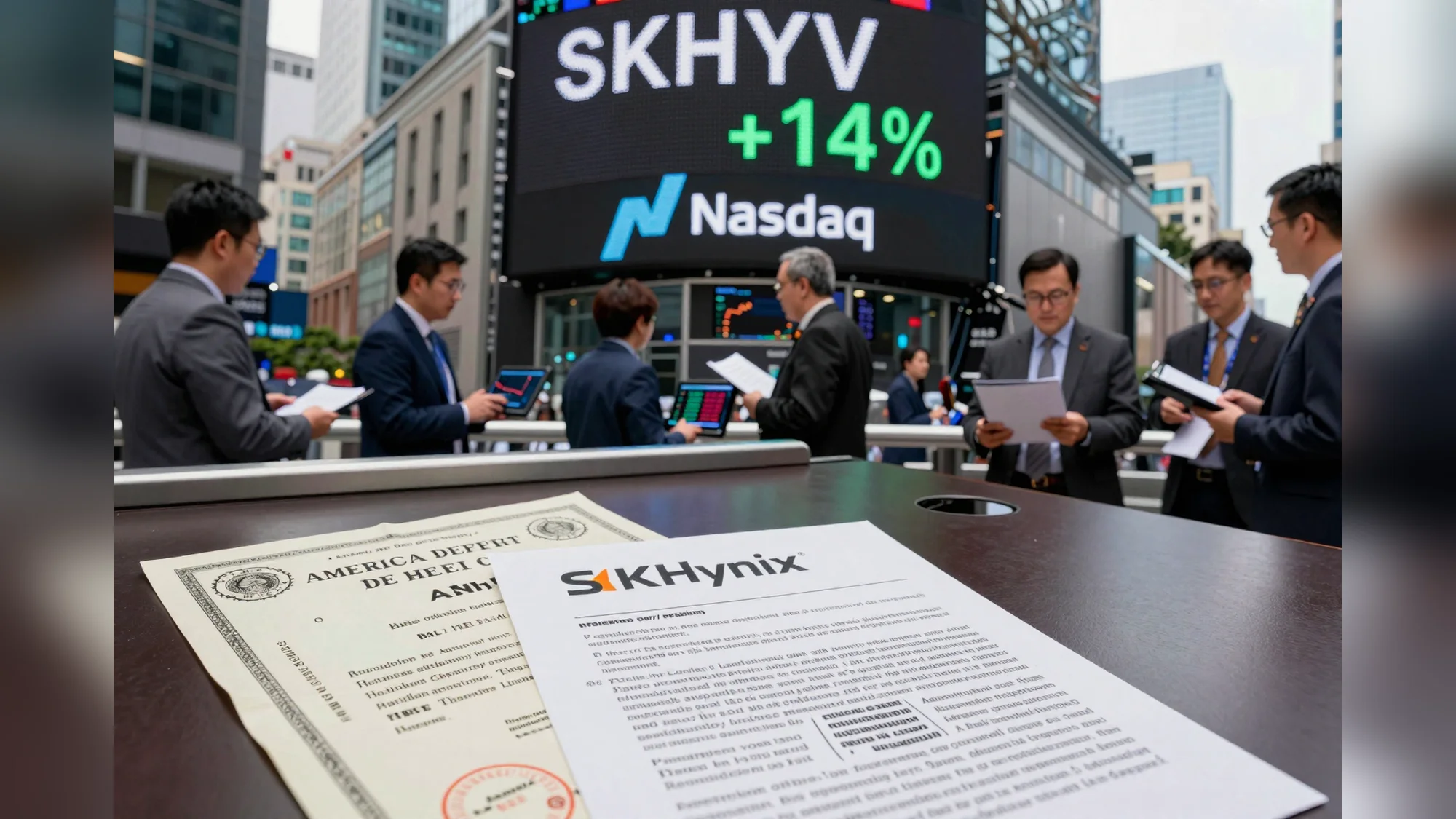
US investors paid up for SK Hynix's AI-era memory exposure, allowing the company to raise $26.5bn in a US IPO even though the ADRs priced roughly 2.7% above the three-day average in Seoul. The proceeds came from the sale of 177.9 million American depositary receipts at $149 each, with a Nasdaq listing beginning on July 10 under the temporary ticker SKHYV. The stock opened about 14% above the IPO price in early trading, and regular Nasdaq trading is scheduled to begin on Monday July 13 when the ticker will switch to SKHY.
Deal structure and allocation
The proceeds were raised through ADRs that represent roughly one tenth of a Seoul-listed share, giving US retail and institutional investors easier access while the allocation process favoured large accounts. But TechCrunch reported that roughly half the ADRs were allocated to the 10 biggest investors and that the top 25 accounts received about two thirds of the shares. Demand ran at more than seven times the available stock, according to the same account.
The ADRs were priced at $149 each, producing the $26.5 billion headline figure from the sale of 177.9 million ADRs. That structure also translated into a near-term price lift: TechCrunch said the US-listed securities opened about 14 percent above the IPO price in early trading on July 10. The offering therefore combined a record foreign listing size with a marked short-term market reward for investors who received allocations.
Commercial leverage and policy pressure
It is one thing to raise a record sum, and another to explain why investors were willing to pay up. And TechCrunch noted that SK Hynix is a major maker of high-bandwidth memory used in AI accelerators and that Nvidia currently relies on SK Hynix as one of its primary HBM suppliers. That commercial role is the clearest reason why the US transaction bucked the usual Korea Discount and attracted a premium.

TechCrunch reported how SK Hynix intends to use the proceeds. First, the company will fund construction of a new fabrication plant in South Korea, aimed at easing a global memory shortage driven by AI demand. Second, it will build a new packaging facility in South Korea.
Third, the company will buy advanced equipment including extreme ultraviolet lithography scanners, the devices required for next-generation chip manufacturing.
The listing arrives against a wider policy push to localise chip production. Still TechCrunch reported that Micron has announced plans to invest $250 billion in new US manufacturing, while Korean chipmakers have pledged more than $550 billion for new manufacturing investment in South Korea.
TechCrunch also reported that the U.S. Commerce Secretary told attendees at a Micron event that they have been in talks with Samsung and SK Hynix about building new factories in the United States. Those commitments indicate a competition between governments and producers to secure capacity for AI-relevant memory chips, and they frame why SK Hynix's capital raise matters beyond its balance sheet.
The ADR listing mechanics also matter for market structure. TechCrunch described the temporary SKHYV ticker that began trading on July 10, with regular Nasdaq listing set for July 13 under SKHY. The ADR arrangement simplified US participation but, as the allocation pattern shows, it didn't democratise ownership of the most sought-after shares.
Related Articles
- Cerebras files IPO with $510m revenue
- Yesway files for up to $321m IPO on Nasdaq
- AI optimism lifts US stocks as fragile US‑Iran ceasefire eases risk
Regular Nasdaq trading starts on Monday July 13, when the ADR ticker will change from SKHYV to SKHY. Originally reported by techcrunch.com.
This article was created with AI assistance.


