
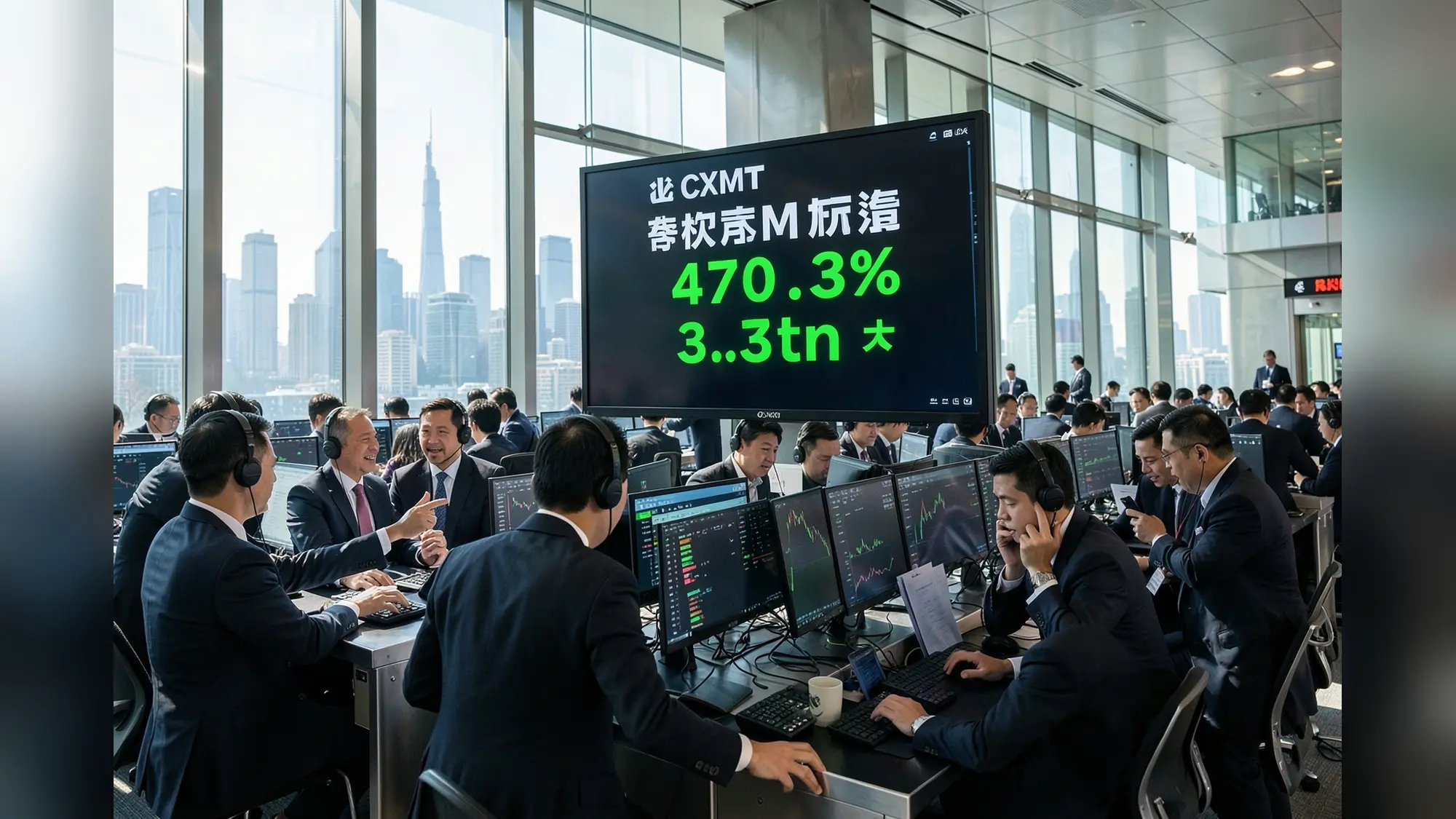
3.3 trillion yuan. ChangXin Memory Technologies surged to about that market capitalisation on its Shanghai STAR Market debut, instantly becoming mainland China’s most valuable listed company. The stock rocketed from an IPO price of 8.66 yuan to opening trade near 49.50 yuan, a roughly 470 percent jump that lifted valuation from about 579 billion yuan at the offer to roughly 3.3 trillion yuan, Reuters reported. Regulators could take comfort from the blockbuster listing after weeks in which markets had lost more than $1.5 trillion, the BBC noted.
3.3 trillion yuan. That number is the immediate read on investor appetite for a domestic memory champion. The rally shifted the ranking of China’s biggest listed names, pushing ChangXin Memory Technologies, known as CXMT, past Industrial and Commercial Bank of China to top the mainland list, Reuters said.
The company makes DRAM chips that feed data centres used to power artificial intelligence, as well as components for smartphones, personal computers and tablets. CXMT raised 57.92 billion yuan in the offering, with proceeds able to climb to 66.61 billion yuan if an over-allotment option is exercised, Reuters added. The firm was founded in 2016 by Chairman Zhu Yiming and is based in Hefei, Anhui province, the BBC reported.
The scale of the debut was driven by a tiny free float. Only 6.73 percent of the company’s enlarged share capital was freely tradable at listing, Reuters said, a limited supply that market participants warned could magnify price swings and trading turnover.

That structure helps explain the dramatic opening move and the intra-session volatility: shares dipped from their opening highs before recovering during the trading day, Reuters reported.
There is a wider market context. Global DRAM capacity is concentrated in a handful of firms, notably Samsung Electronics and SK Hynix from South Korea and Micron from the United States, the BBC and Reuters pointed out. Demand for AI servers and data centres has driven a run-up in memory names, and SK Hynix itself completed a $26.5 billion New York share sale in July, the BBC noted.
The timing matters for Chinese authorities. Markets had slumped in the weeks before the IPO, losing more than $1.5 trillion, the BBC said, and Beijing has been deploying measures to arrest that decline. The headline-grabbing CXMT listing offers a visible demonstration of retail and institutional demand for marquee domestic chip firms even as local trading navigates volatility, Reuters added.
Market commentary carried in Reuters cautioned that the initial revaluation is a sensitive gauge of investor sentiment. At the IPO price CXMT was valued at about 579 billion yuan, and the opening session revalued it to roughly 3.3 trillion yuan within minutes. That kind of re-rating, given the small free float, leaves the stock exposed to sharp moves as money rotates between growth technology names and safer sectors.
Operationally, CXMT plans to use the bulk of IPO proceeds to expand production capacity and fund research and development, the BBC reported. That ambition sits against tight global memory markets and a scramble for supply to serve AI infrastructure, a dynamic that has lifted the sector’s appeal to investors.
Related Articles
Only 6.73 percent of CXMT’s enlarged share capital was freely tradable at listing, a structure likely to amplify price swings as the market awaits the over-allotment decision.
This article was created with AI assistance.


