
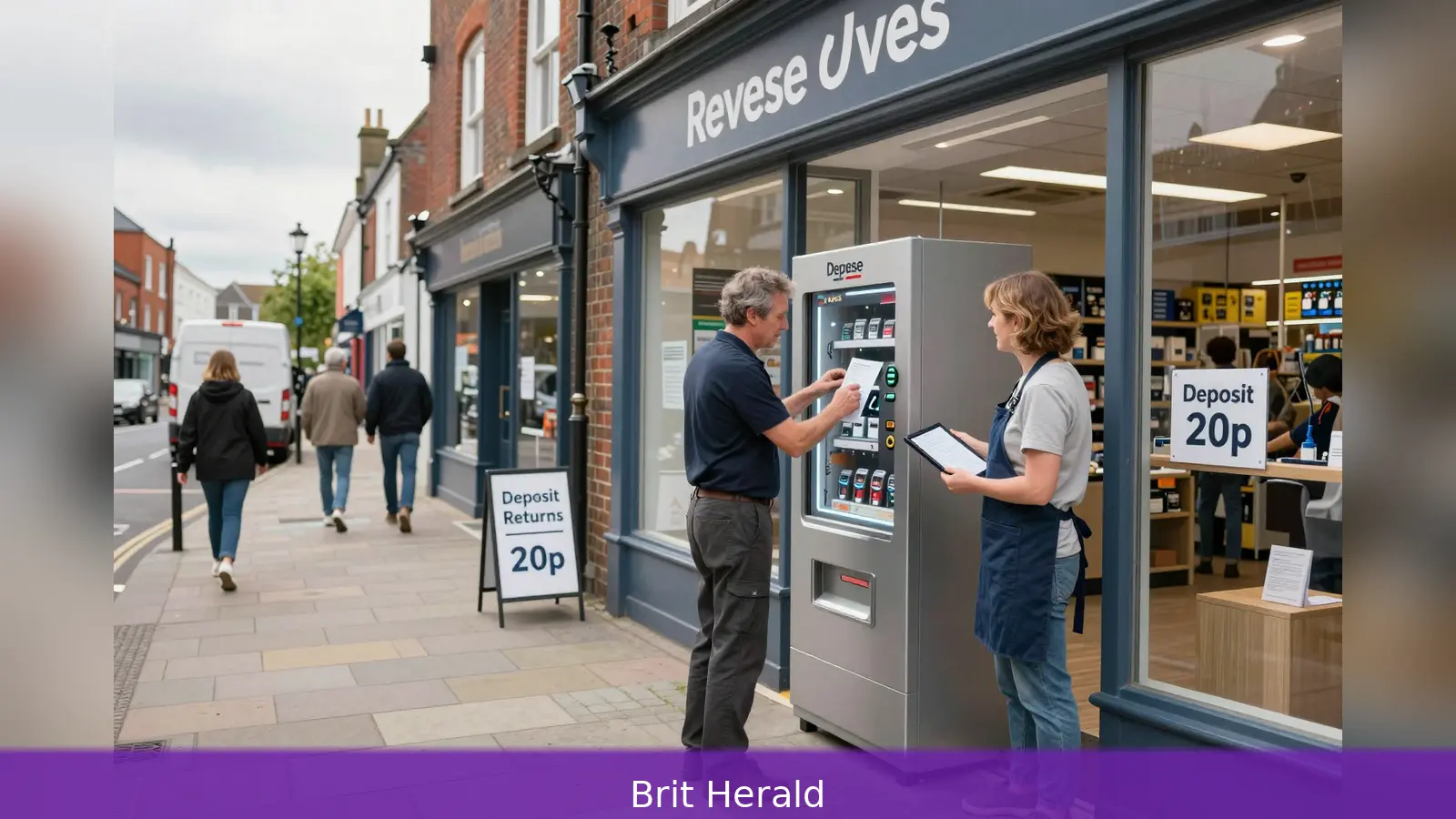
£60m. That's the headline sum being offered as a grant pool to help small, independent retailers install Reverse Vending Machines ahead of the UK Deposit Return Scheme. The package, run by Exchange For Change, covers up to 10,000 sites at a headline rate of £6,000 per qualifying location, paid as three annual instalments of £2,000 once an RVM is installed, and it arrives alongside published Return Handling Fee tiers and expanded exemption rules. Detailed application mechanics will be published in Q3 2026 and the industry has set October 2027 as the target date to have the scheme operating across England, Scotland and Northern Ireland.
1. What the package contains
£60m is being underwritten by Exchange For Change as a dedicated grant fund to reduce the upfront cost of becoming a return point for the Deposit Return Scheme. The intention is explicitly practical: help retailers meet equipment and set-up costs, including purchasing a Reverse Vending Machine, training staff and meeting site requirements so stores can accept returned containers.
The industry body has sized the programme to assist up to 10,000 small, independent retail sites. Grants are set at £6,000 per qualifying site and will be paid in three equal instalments of £2,000. Payments will be triggered after an RVM is installed, with instalments funded three months after installation. Exchange For Change’s chief executive, Russell Davies, said the package is designed to help retailers "make the best choice for their business, whether that’s installing an RVM or applying for an exemption," and that the support follows extensive industry consultation.
The package sits beside a confirmed schedule of the scheme’s retail payments, the Return Handling Fee or RHF. Exchange For Change has published RHF tiers that will reimburse retailers for taking back containers. The published structure differentiates between manual and automatic return points and reduces the per-container rate for very large volumes. Those fees are intended to contribute towards equipment purchase, staff training and the use of retail floor space for collection and storage.
2. Who can claim grants and who can seek exemptions
Automatic exemptions under the Deposit Return Scheme regulations already exist for urban retailers with a sales area under 100 m2. Exchange For Change has negotiated an extension of that baseline with regulators so that urban stores with sales areas of 100 to 199 m2, and rural retailers with under 200 m2 of sales area, may apply for a size-based exemption. These extensions don't create automatic entitlement; they create an application route that didn't previously exist.
Additional grounds for exemption applications include proximity to existing return points, restrictions due to heritage or listed building status, site access problems and a lack of necessary utilities. Exchange For Change will act as the approval authority for exemption applications. Approvals will be dependent on there being enough local provision of return points so consumers still have reasonable access to reclaim deposits.
There is a clear line the industry is drawing around larger grocery stores. The scheme maintains a presumption against granting exemptions to grocery retailers with retail space of 200 m2 or more. That means larger supermarkets should generally expect to be required to provide return points, though Exchange For Change will still accept applications from larger grocers that can demonstrate exceptional circumstances.
For retailers weighing whether to apply for an exemption or to install an RVM, the practical steps are straightforward and precise. You should audit your sales area, confirm whether your location is classed as urban or rural under the DRS definitions, and document any site-specific constraints that match the allowed exemption grounds. Keep clear evidence if you are near the 200 m2 threshold and think exceptional site characteristics may apply.
3. How to apply and the practical sequence
10,000. That's the number of sites the grant fund is sized to help and it matters because the grant payments are site-level and conditional. Grants are paid after a qualifying RVM is installed, so the sequence of actions for a retailer who wants support is important.
First, determine whether the site meets the published thresholds for automatic exemption or for a size-based application. Second, if you plan to seek a grant, procure and install an RVM that meets the scheme’s technical requirements so that grant instalments can be triggered, because payments are scheduled after installation. Third, complete the grant application and any verification Exchange For Change requires once the detailed application process is published.

Fourth, register to operate a return point with the scheme operator and put in place staff training, storage and signage to manage returned containers. Fifth, account for Return Handling Fee receipts in operating budgets and understand the differing fee rates for manual versus automatic return handling and the volume threshold where the lower automatic rate applies.
The grant instalment timing is consequential for cash flow. Grants are underwritten at £6,000 but paid as three annual payments of £2,000, and instalments are funded three months after installation. That means the upfront capital still needs to be found by the retailer or advanced by suppliers, with the expectation of staged reimbursement. Exchange For Change has made clear the grants target upfront equipment and set-up costs rather than long-term operating expense.
Before the full application materials are published, retailers should take preparatory steps that will be reusable once the formal process opens. Measure your retail floor space precisely. Document planning or heritage constraints. Obtain preliminary quotes for RVM equipment and installation. Model expected return volumes and how the RHF will feed into margins under two scenarios, manual handling and automatic handling. Estimate what the published RHF structure would mean for your cash flow at expected daily and annual return rates.
4. Practical choices, cross-border complications and timing
The Deposit Return Scheme will apply to single-use drinks containers made from PET plastic, steel and aluminium in volumes from 150 ml to 3 litres. Consumers are expected to pay a 20p deposit at point of sale and reclaim it on return. Those technical design choices shape equipment needs, customer flows and back-room storage requirements for participating retailers.
Businesses that operate across UK nations should factor in divergent political decisions. Wales has announced it won't proceed with the UK-wide DRS and intends to develop its own scheme that may include glass as well as reuse measures. The Welsh Cabinet Secretary for climate change and rural affairs, Huw Irranca-Davies, said Wales will now pursue a scheme tailored to its goals for reuse and glass containers. The British Soft Drinks Association’s director general, Gavin Partington, warned that Wales’s decision could increase complexity for cross-border trading and compliance, while the trade body said it remains committed to a DRS for cans and PET by October 2027.
That divergence raises practical questions for retailers and suppliers whose operations cross the Wales-England border. Equipment compatibility, collection schedules and label or barcode standards are all areas where different schemes can add friction. Retailers with cross-border trade should track Welsh policy as it develops and look at the implications for supply chains and RVM compatibility.
Finally, timing matters. Exchange For Change has said the detailed eligibility criteria for grants and the full application route will be published in Q3 2026.
The industry target for operation across England, Scotland and Northern Ireland is October 2027. Those two dates are the firm milestones retailers should plan around: use the Q3 2026 publication as your formal application trigger and have installations and registrations completed ahead of the October 2027 operational deadline if you plan to accept returns or to have an exemption approved in time.
In short
Measure your sales area now and document constraints that could support an exemption.
Get preliminary quotes for RVMs and installation, because grants pay after installation and are paid in three instalments of £2,000.
Model the RHF income against expected return volumes so you understand the operating case.
If you trade across Wales and England, factor in potential differences in scheme design and equipment compatibility.
Related Articles
- How AI Picks Sources: 3 Criteria to Win Mentions
- How a startup can make one founder a billionaire in months
- 6-step Gemini workflow to boost YouTube clicks
Look out for the detailed application guidance and full eligibility criteria in Q3 2026; October 2027 is the industry target for the scheme to be operational across England, Scotland and Northern Ireland.
This article was created with AI assistance.


